Doctor-On-Demand App Development
Since 2001, IT Craft has been helping healthcare software product companies, startups, and providers build user-friendly doctor-on-demand apps.
 Overall review rating
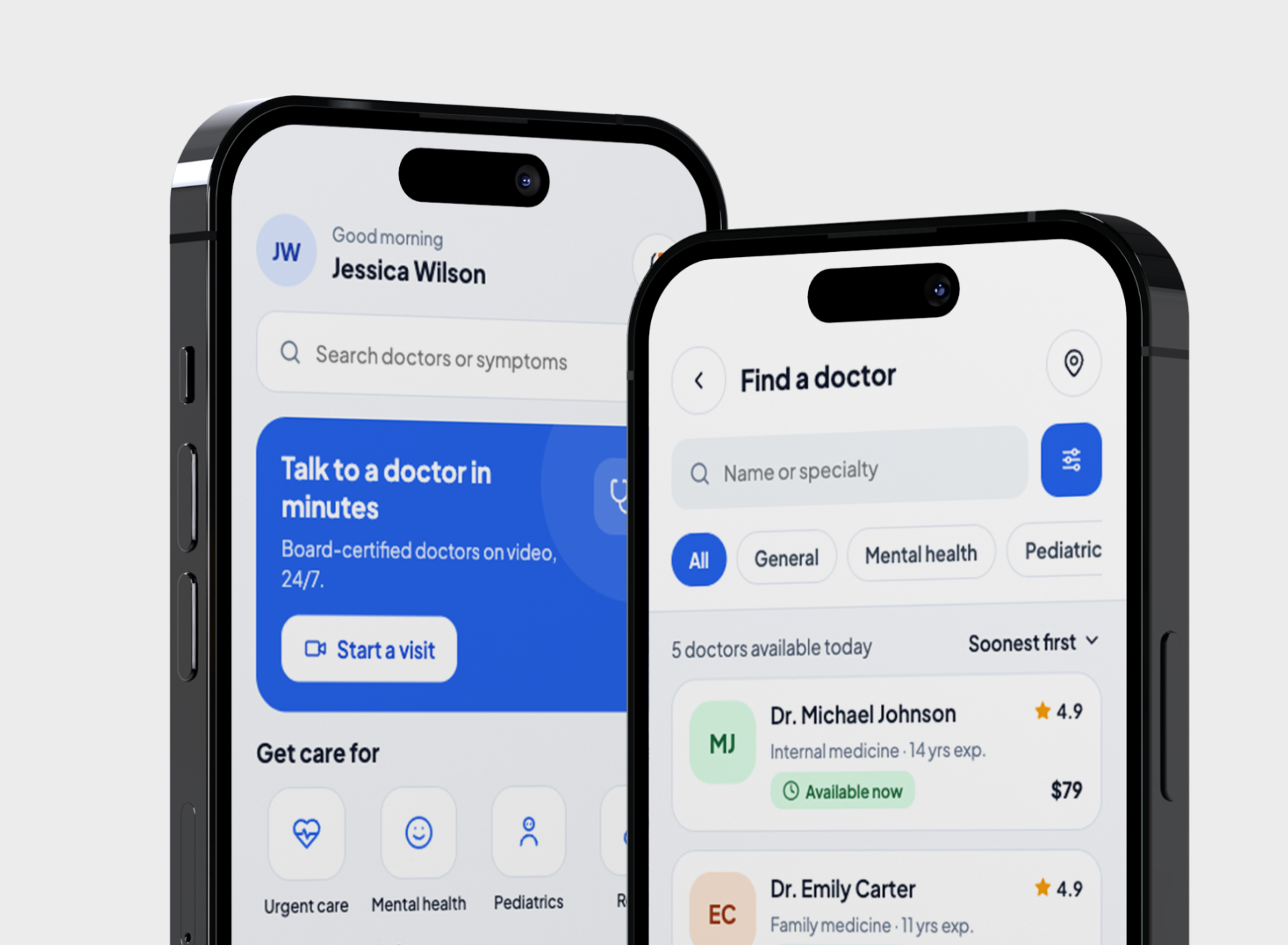
Doctor-on-demand app development lets healthcare organizations provide virtual urgent, primary, preventative, and chronic care, with e-prescribing and medication mailing, treatment management, and in-app billing in one place. IT Craft can build such an app to run on-demand online consultations over video and chat, connected to your EHR, pharmacies, and payment systems.
Common Challenges and How We Solve Them
Below are the issues healthcare clients most often bring to IT Craft’s engineers when building doctor-on-demand apps, and how we handle each of them.
| Challenge | Solution | |
|---|---|---|
| Reliable Real-Time Video | It may be hard to keep video consultations stable when patients join from weak mobile networks or from behind corporate firewalls. | IT Craft ensures connection stability at every stage of a call, from WebRTC and STUN/TURN servers to adaptive bitrate streaming and global media servers. |
| Complex EHR and EMR Integrations | EHR/EMR interoperability is often limited by legacy systems and inconsistent data formats used by different vendors. | We conntect doctor-on-demand apps with EHR/EMR systems via FHIR APIs and HL7 messaging. For systems without standard interfaces, integration engines are set up. |
| Patient Data Protection | It may be hard to keep a doctor-on-demand app secure when PHI flows through dozens of video calls, chats, and integrations. | Our engineers implement PHI safeguards at every level of the app, from Zero Trust architecture and end-to-end encryption to role-based access control, multi-factor authentication, and audit logs. |
| Handling Peak Consultation Volumes | An app designed for average traffic may not withstand seasonal spikes in consultations, so scalability & performance should be planned from the start. | IT Craft’s architects design cloud infrastructure on Kubernetes with auto-scaling, load balancing, caching, and message queues that ensures high availability. |
| Consistent Cross-Platform Performance | Cross-platform development is associated with the risk of uneven performance on different devices, browsers, and network speeds. | Responsive interfaces are checked through device and browser testing on real hardware, with cross-platform frameworks or native development chosen for each feature set. |
| Preventing Scheduling Conflicts | Fragmented calendars stored across several systems lead to double bookings and missed visits. | Schedules from multiple systems are consolidated into centralized calendars with real-time synchronization, overlap detection, automated reminders, and waiting lists. |
| Meeting Regional Compliance Requirements | For organizations serving patients in several countries, HIPAA, GDPR & HITECH requirements apply to every stage of data processing. It is crucial to account for them before the app goes live. | Customizable consent, regional data storage, audit trails, and security controls are built into app workflows from the start. |
| Safe and Reliable AI | AI reliability cannot be ensured once and for all, as model accuracy may drop with each new patient dataset. | In addition to validated medical datasets and model accuracy checks, IT Craft provides physician oversight before releases and post-launch monitoring with controlled model updates after launch. |
Doctor-On-Demand App Development Costs & Timelines
Based on industry benchmarks, the cost of doctor-on-demand app development may range from $35,000 to $350,000+, depending on app complexity, the number of platforms and integrations, as well as security and compliance requirements.
| Solution Scope / App Type | Typical Cost Range | Estimated Timeline |
|---|---|---|
| Basic Consultation App (MVP) | $35,000–$90,000 | 2–4 months |
| Mid-Complex Telehealth Platform | $90,000–$200,000 | 4–8 months |
| Enterprise / AI-Powered Platform | $200,000–$350,000+ | 8–12+ months |
Core Cost and Timeline Drivers
Major factors that affect the app budget and timelines are:
- The required regulatory compliance (HIPAA, HITECH, GDPR, etc.).
- The number and complexity of integrations (e.g., EHR/EMR, pharmacies, insurers), including approvals for EHR data access.
- The number of platforms and the share of native vs. cross-platform development.
- The type of video communication (third-party APIs like Twilio vs. custom WebRTC).
- The level of feature sophistication (standard booking and chat vs. AI-powered symptom assessment and wearable sync).
- Ongoing expenses for cloud hosting and video API subscriptions, third-party licenses, and staff training.
- (for outsourced development) A vendor’s service pricing model.
Types of Doctor-On-Demand Apps We Build
IT Craft builds custom doctor-on-demand apps for patients, hospitals, specialty practices, and employers, with data flowing between apps and EHRs in real time.
B2C Consultation Apps
- Video/chat consultation apps
- Virtual primary care apps
- Specialist booking apps (e.g., for dermatologists, cardiologists)
- Digital prescription software
- Follow-up care apps
Hospital-Owned Platforms
- Virtual clinics for hospitals and health systems
- Outpatient care software with EHR integration
- Hybrid care platforms (e.g., in-person visits with video follow-ups)
- Hospital telehealth portals
Specialist Consultation Platforms
- Referral management systems
- Second opinion platforms
- Team consultation software
- Specialty telehealth apps (e.g., cardiology, oncology, dermatology, neurology)
Mental Health Apps
- Video counseling apps for psychiatrists and therapists
- Behavioral health assessment tools
- Medication tracking apps
- Crisis response systems
- Digital therapy programs
Chronic Care Platforms
- Chronic disease management apps (e.g., diabetes, high blood pressure, heart disease)
- Continuous tracking platforms
- Medication alert apps
- Care plan management software
Remote Patient Monitoring Apps
- Remote patient monitoring platforms
- Connected device software (e.g., glucometers, blood pressure cuffs, wearables)
- Vital signs and live health data dashboards
- Clinical alert systems for care coordinators
Corporate Health Platforms
- Employee benefits platforms
- Virtual primary care and preventive program software
- Mental wellness apps
- Work-site consultation systems
Must-Have Doctor-On-Demand Software Features
A software development company with 20+ years in healthcare IT, IT Craft lists the key features for doctor-on-demand apps that are most frequently requested by our clients. Along with core telemedicine functionality, such apps usually include e-prescribing, medication mailing, treatment management, and in-app billing.
Appointment Scheduling and Management
- Filtered doctor search (e.g., by specialty, language, availability).
- Smart matching with available doctors and one-tap urgent requests.
- Booking, canceling, and rescheduling with calendar sync.
- Doctor availability management.
- Appointment reminders (SMS, email, push).
- Automated processing of referrals to specialists.
- Post-visit provider ratings and reviews.
Patient-Doctor Communication
- Pre-visit patient questionnaires.
- Audio and video consultations, including store-and-forward telemedicine for case review.
- Instant secure messaging with chat history.
- Secure storage for consultation recordings.
Treatment and Medication Support
- In-app access to patient records and visit history.
- In-app uploading of medical documents and lab files.
- Lab test assignment, lab reports, and medical image review.
- Custom or template-based creation of treatment plans and clinical notes.
- In-app e-prescriptions and refills.
- In-app activation of medication mailing.
- Medication intake log and reminders.
- Clinical decision support.
Patient Self-Management
- Vitals tracking via manual entry or wearable integration.
- Daily symptom logging.
- Symptom assessment for initial triage.
- Patient education materials with condition-specific articles and pre- and post-visit instructions.
- Peer support communities for patients with similar conditions.
- Personalized health guidance on diet, sleep, and activity.
- Condition-specific audio and video exercises.
Healthcare Analytics and Reports
- Automated KPI tracking (e.g., care quality, patient outcomes, engagement).
- Financial analytics, including doctor earnings tracking.
- AI-powered predictive analytics to forecast demand, identify high-risk patients, etc.
- Operational performance monitoring (e.g., wait times, no-show rates).
- Data visualization via customizable dashboards and reports.
Payments and Insurance
- In-app payment processing and refunds via integrated payment gateways.
- Support for multiple payment methods (card, bank transfer, mobile wallet, HSA, FSA, etc.).
- Invoicing.
- Patient eligibility check and insurance verification.
- Automated claim submissions.
- Electronic Prior Authorization.
App Accessibility
- Text-to-speech functionality.
- Voice recognition.
- Multilingual support.
- Accessible UI for reduced cognitive load.
- High-contrast mode for users with low vision or color blindness.
- Assistive technology integration, such as screen readers, braille displays, and switch controls.
Data Security and Compliance
- Role-based access and identity management.
- Multi-factor and biometric authentication.
- End-to-end encryption.
- Audit logs of user activity.
- Regulatory compliance with HIPAA, HITECH, GDPR, and other applicable regulations.
- Data exchange according to HL7, FHIR, and DICOM standards.
Doctor and Admin Tools
- Doctor profiles and credential verification (e.g., licenses, board certifications).
- Patient and doctor account management.
- Live consultation dashboards.
- Content and notification management.
- Dispute resolution and customer support tools.
AI-Powered Features
- AI-based symptom assessment.
- Smart doctor matching and scheduling.
- AI medical scribe for visit notes.
- Chatbots for patient support.
- Personalized health guidance based on patient data.
Architecture
Architecture of a Doctor-On-Demand App
Doctor-on-demand apps are built on cloud-native architecture with a layered design, where separation of application components ensures high availability and scalability and allows independent service evolution.
User Interface Layer
Provides patient apps, doctor portals, and admin dashboards; connects them to back-end services via REST APIs or GraphQL.
Application Logic and Microservices Layer
Handles scheduling and visit management, billing, authentication and notifications as separate microservices; connects them via REST APIs and gRPC; streams events between services with Apache Kafka.
Real-Time Communication Infrastructure
Delivers low-latency audio/video via WebRTC; sets up secure sessions through signaling servers; ensures NAT and firewall traversal with STUN/TURN servers.
Healthcare Integration Layer
Connects the app with EHR/EMR systems, laboratories and diagnostic systems, pharmacies and insurers via HL7 and FHIR, including SMART on FHIR app launch inside the EHR.
AI and Data Analytics Layer
Powers symptom assessment, ambient clinical documentation, and doctor matching; runs patient risk analysis; visualizes key metrics in operational dashboards.
Cloud Infrastructure and Deployment
Containerizes and orchestrates app services with containers and Kubernetes to support fast and stable delivery; routes traffic through API gateways and load balancers; adds caching; automates releases via CI/CD pipelines with centralized logging and monitoring.
Security and Access Controls
Verifies users via OAuth 2.0 and OpenID Connect; controls access with MFA/SSO/RBAC; encrypts data with TLS and AES-256 encryption; ensures key management; detects threats through audit logs and SIEM.
Doctor-On-Demand App Development Roadmap
Doctor-on-demand app development is a project requiring special attention to compliance requirements, performance, and user convenience. Below, our team shares a sample outline of steps we follow in step-by-step doctor-on-demand app development.
-
Business Discovery and Requirements
- Analyzing the target audience (demographics, care needs, pain points) and the competitors’ offerings, defining a value proposition.
- Mapping clinical workflows for doctors and patients (booking, video visits, prescribing, billing, follow-ups).
- Eliciting functional and non-functional requirements for the solution and creating a software requirements specification.
- Determining the project scope, roadmap, timeline, and team.
- Defining KPIs for project progress assessment.
- Creating a business case and preparing a cost estimation and ROI calculation.
- Designing a risk mitigation plan.
-
Regulatory and Compliance Planning
- Identifying the applicable healthcare regulations to comply with, e.g., HIPAA and HITECH (for the US), GDPR (for the EU).
- Defining patient data governance rules (data collection, storage, retention, and deletion).
- Planning role-based access control for patients, doctors, nurses, and admins.
- Planning HL7/FHIR interoperability with EHRs, labs, and pharmacies.
- Defining audit logging requirements.
-
Design and User Experience
- Creating patient and doctor personas and mapping user journeys for each of them.
- Building UX wireframes and prototypes.
- Performing usability testing.
- Designing an attractive and accessible user interface.
-
System Architecture and Infrastructure
- Outlining the solution’s modular architecture, technology stack, and integration plan (e.g., EHR/EMR, wearables).
- Setting up cloud infrastructure with load balancing and auto-scaling.
- Setting up environments for development and delivery automation (e.g., container orchestration, CI/CD).
-
Development and Integration
- Building the app’s front end (patient/doctor/admin interfaces) and back end.
- Integrating the app with EHR and other required systems, including pharmacies, insurers, and payment gateways.
- Implementing real-time video and messaging.
- (Optional) Adding AI capabilities (e.g., symptom assessment, smart doctor matching, AI scribe).
- Setting up secure authentication.
-
Testing and Quality Assurance
- Conducting quality assurance throughout the development, including functional, integration, and security testing.
- Evaluating the solution’s load and performance in different usage scenarios.
- Ensuring the app’s accessibility.
- Carrying out compliance checks.
-
Deployment and Launch
- Setting up the production environment and CI/CD pipelines.
- Updating and finalizing software documentation for smooth compliance certification (e.g., in accordance with HIPAA, HITECH, and FDA 21 CFR Part 11 requirements).
- (Optional) Assisting with FDA submission and the regulatory clearance process.
- (Optional) Carrying out beta testing (launching the app to a limited group of real users) and adjusting the app based on user feedback.
- Training medical and admin staff.
- Launching the application.
-
Monitoring and Future Expansion
- Introducing new physician- and patient-facing features, customization capabilities, and integrations.
- Improving the solution’s non-functional capabilities, such as performance or interoperability, based on performance monitoring, user feedback, and usage analytics.
- Conducting ongoing compliance checks and performing timely bug fixing.
Technology Stack
Security and Compliance
Security and compliance are planned from the first sprint, so the app meets regulations without costly rework.
HIPAA
US healthcare apps need PHI protection under HIPAA. This includes strict access controls, audit trails, encrypted messaging, and signed Business Associate Agreements with every vendor that handles patient data.
GDPR
For EU patients, GDPR requires explicit patient consent, data minimization, patient record access on request, and breach reporting within 72 hours. Some countries also set data residency rules.
HITECH
HITECH extends HIPAA to electronic health records, adding breach reporting, vendor accountability, record security, and access history requirements.
FHIR & HL7 Interoperability
HL7 messaging connects the app to older hospital systems, while FHIR APIs make it easier to share patient records, prescriptions, and lab results.
Identity & Access Management
MFA, SSO, OAuth 2.0, and OpenID Connect verify every user, and RBAC limits what each role can see.
Data Encryption & Audit Logging
TLS 1.2/1.3 protects data in transit, and AES-256 protects it at rest. User activity logs and record access tracking simplify security audits.
Secure API & Infrastructure Practices
API keys, rate limiting, secrets management, and Web Application Firewalls protect connections to EHRs, pharmacies, and labs. Regular penetration testing finds weak spots before attackers do.
Our Software Development Services
Consulting
Our team will conduct a project feasibility assessment, advise on architecture planning and UX/UI design, and work out the integration plan. We will provide regulatory guidance throughout development and help you prepare the app for a smooth market launch.
Full-Cycle App Development
IT Craft is ready to take on every part of app development for you, from market and audience analysis to coding and QA and deployment. We will build in the applicable compliance features and can offer ongoing software support after the release.
Why Develop a Doctor-On-Demand App with IT Craft
- Since 2001 in software development, 20+ years in healthcare IT.
- 2,250+ delivered projects.
- 330+ IT experts skilled in healthcare software development.
- Mature Agile and DevOps practices.
- Experience with FHIR/HL7 interoperability, AI capabilities, and cloud-native architecture.
- HIPAA/GDPR-oriented development.
- Telehealth modernization of existing platforms.
Key Roles in Doctor-On-Demand App Development Projects
Project manager
Coordinates the project and stakeholder communication; manages schedule and quality risks; ensures timely delivery.
Healthcare IT consultant
Conducts market research and competitor analysis; elicits requirements; defines the app’s features and integrations.
Software architect
Designs the solution architecture; plans EHR, LIS, and wearable integrations; selects the tech stack.
UX designer
Studies user needs; creates personas and scenarios; builds wireframes and prototypes; runs usability and accessibility testing.
UI designer
Designs patient, physician, nurse, and admin interfaces; improves the visual design based on user feedback.
DevOps engineer
Sets up containerization and workflow automation; manages deployment; monitors app performance and availability.
Front-end developer
Builds the GUI according to accessibility guidelines; makes code fixes after testing.
Back-end developer
Develops the cloud telehealth platform; makes back-end code fixes.
Mobile developer
Builds iOS apps and Android apps.
QA engineer
Creates a test strategy, test plans, and test cases; runs functional and non-functional testing; reports defects and verifies fixes.
Regulatory consultant
Reviews the architecture, tech stack, and development process for compliance (e.g., with HIPAA and GDPR).
Cybersecurity specialist
Conducts risk assessment; finds architecture and code vulnerabilities; defines security requirements; sets up access controls.
Engagement Models
In-house
+ Full project control.
- Limited scalability and slow skill acquisition.
- Internal team takes full responsibility for delivery, QA, and compliance.
Staff Augmentation
+ Cost-effective access to specialized competencies.
+ Scalable team capacity.
- Possible management and communication challenges with remote specialists.
Outsourcing
+ Faster delivery and optimized budget thanks to the vendor’s talent pool.
+ Self-managed teams responsible for the final product.
- Vendor selection risks.
FAQ
Yes, but how depends on your EHR vendor’s capabilities. Some vendors offer FHIR APIs and SMART on FHIR, while others require HL7 messaging, integration platforms, or custom development. Once connected, doctors get patient records, prescription and medical history access and don’t need to switch between systems.
There are two options: WebRTC for low latency and native encryption, and third-party APIs (e.g., Twilio Video, Agora and Vonage) for a faster launch.
By taking over routine tasks around each visit, for example, symptom assessment, doctor matching, appointment scheduling, clinical documentation, and personalized health alerts.
The main goal is stable performance at any load. Cloud infrastructure and microservices let services grow separately, load balancing and auto-scaling handle traffic peaks, and database performance and caching keep responses fast.
A good app is almost invisible to its users: MVP validation before full launch, role-specific UX/UI, doctor verification, and security and compliance planning from the first sprint. Performance monitoring and staff training after launch add to the result.
B2C apps usually earn through pay-per-consultation and subscriptions or marketplace commissions. B2B platforms rely on enterprise licensing, insurance reimbursement and corporate healthcare programs, and premium AI services.
Tools that cut routine work and connect care, for example, ambient AI and medical scribes, SMART on FHIR and FHIR R5, and remote patient monitoring and IoMT. Under the hood, cloud-native and Kubernetes architecture and Zero Trust security and AI governance are becoming the norm.
Contributor
-
Healthcare IT Expert & Consultant