EHR Integration Services
Since 2001, IT Craft has been providing EHR/EMR integration consulting and implementation for medical IT ecosystems and healthcare software products.
 Overall review rating
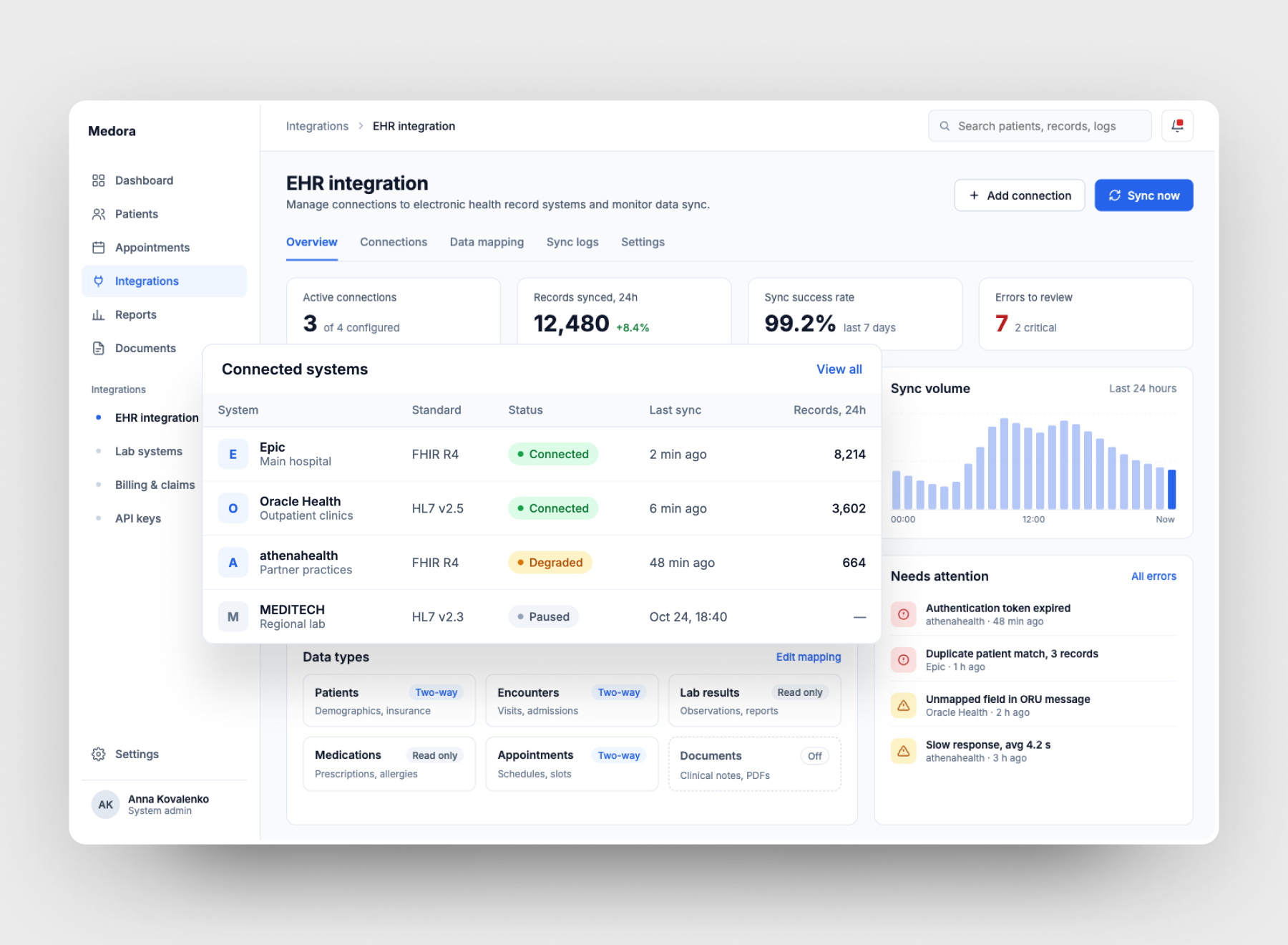
EHR data integration connects telehealth, labs, practice management, billing, patient portals, medical devices, and analytics with the EHR, so every system works with the same patient records. IT Craft’s engineers build these connections with secure APIs, middleware, HL7, and FHIR to keep data exchange accurate across your healthcare software.
Challenges & Solutions
Below are the most common challenges our clients face when integrating EHR systems, along with the approaches IT Craft integration engineers use to overcome them.
-
A telehealth product may need two-way data exchange with Epic, especially when patient history, consultation notes, and prescriptions should sync automatically.
Our engineers connect telehealth products to Epic via FHIR APIs and SMART on FHIR, from pulling patient history before a visit to writing back consultation notes and prescriptions.
-
Clinical systems from different vendors often fail to exchange data, as each of them uses its own formats and interfaces.
A middleware layer based on an integration engine translates HL7 v2 messages and FHIR resources and routes them between hospital systems.
-
Disconnected EHR/EMR platforms, labs, pharmacies, and billing systems slow down both clinical and administrative workflows.
Our team connects them via HL7, FHIR, and vendor APIs. For systems without standard interfaces, custom APIs are developed.
-
For organizations working with several EHR vendors, integration gets more complicated with each new platform. Epic, Oracle Health, athenahealth, and MEDITECH each come with their own APIs, data models, and access requirements.
With HL7 v2, FHIR, and SMART on FHIR at hand, our engineers know how to work with vendor-specific workflows and build integrations that fit the existing ecosystem.
-
Manual data entry takes up clinicians’ time and leads to duplicate and inconsistent patient records.
Data exchange across clinical workflows is automated, with patient matching and duplicate management.
-
It may be hard to prove HIPAA compliance when PHI flows between several systems and vendors.
In addition to HIPAA-ready architecture and encrypted data flows, IT Craft sets up audit trails and provides full documentation for regulators and investors.
EHR Integration Costs & Timelines
Based on average market rates, the cost of EHR integration may range from $5,000 for basic read-only access to $1.2M+ for enterprise, multi-endpoint systems, with timelines from 2 weeks to 9+ months, depending on the number of connected systems, the EHR vendor, as well as security and compliance requirements.
| Integration Level | Estimated Cost | Typical Timeline |
|---|---|---|
| Basic | $5,000–$15,000 | 2–4 weeks |
| Mid-level | $15,000–$30,000 | 1–3 months |
| Enterprise / Custom | $80,000–$1.2M+ | 6–9+ months |
What an Initial Quote May Leave Out
Secondary technical expenses may add 30–50% to the initial quote:
- EHR vendor API fees (recurring connection fees or charges for specific data endpoints).
- Legacy data migration (10,000–50,000, depending on record volume).
- Compliance audits (HIPAA risk assessments, penetration testing, and security architecture reviews for 15,000–50,000).
Types of Software We Integrate with EHR Systems
IT Craft builds custom EHR integrations for telehealth, lab, hospital management, and analytics software, with data flowing between systems in real time.
Patient-focused software
- Telemedicine apps
- Patient engagement software (e.g., patient portals, wellness apps, mHealth)
- Chronic disease management apps
- Digital therapeutics
- SaMD for disease management and treatment
Software for physicians
- Clinical decision support systems
- Prescription management software
- Diagnostic SaMD (e.g., tumor identification, drug prescription assistance)
- Physician portals
Clinical operations software
- Hospital and practice management systems
- HIE and healthcare CRM systems
- Clinical trial and healthcare analytics software
- Diagnostic systems (LIS/LIMS, medical imaging, RIS)
- Pharmacy and financial management systems
IoT-enabled medical software
- Medical IoT and remote patient monitoring platforms
- Virtual hospital and home healthcare software
- Patient tracking software
- Hospital asset tracking and inventory management software
- Medical device and equipment software (e.g., insulin pumps, CT scanners)
Our EHR integration approaches
Centralized data storage
Healthcare data from different sources is brought to a unified format and consolidated in centralized databases or data warehouses.
API-based integration
We connect medical software to the EHR via integration APIs for fast and secure data transfer in line with healthcare standards.
RPA-based integration
For legacy healthcare platforms without APIs, robotic process automation takes over repetitive tasks and keeps EHR/EMR connectivity in place.
Why Choose IT Craft for EHR Integration
- Since 2001 in software development and 20+ years in healthcare IT.
- Integration and database architects with 6-10 years of experience.
- Experience with healthcare standards and regulations: HL7 v2, FHIR, CCD/CDA, DICOM, HIPAA, HITECH, and GDPR.
- Data mapping with clinical code sets (ICD-10, CPT, SNOMED CT, LOINC).
- API-based and message-based integration, microservices, and SOA.
- Experience with Epic, athenahealth, Cerner, GE Healthcare, Allscripts, NextGen, and custom EHRs, both cloud and on-premise.
- Lean, Agile, and DevOps practices with 2-week sprints.
- BAAs signed for every project with access to PHI.
Benefits of EHR Integration
EHR integration saves healthcare teams from duplicate data entry and slow access to records by setting up a coordinated data flow between systems.
Improved operational efficiency
No need to re-enter patient data in several systems, as automated data exchange cuts duplicate entry and paperwork. Faster clinical workflows can increase medical staff efficiency by up to 20% and improve clinician satisfaction.
Better care coordination and patient engagement
Up-to-date patient records from telehealth, labs, scheduling, and billing are available to every provider involved in care. This supports coordinated treatment plans, smoother care transitions, and patients’ participation in their own care.
Reduces medical errors
Complete patient information at the point of care supports timely clinical decisions. 75% of clinicians using EHR-integrated apps say that easy access to comprehensive patient data helps them prevent medical errors.
Stronger data security and compliance
Centralized access controls and audit trails strengthen HIPAA compliance and keep patient data confidential and consistent across systems.
Lower operational costs
Organizations reduce administrative overhead, duplicate tests, and costly medical errors by optimizing clinical processes around a single data flow.
Scalable EHR connectivity
Vendor-neutral connectors and integration middleware let you add new healthcare systems, locations, and specialties without a full platform rebuild, even as transaction volumes grow.
EHR Integration Service Options
IT Craft helps hospitals, practices, and telehealth platforms with EHR integration at every stage, from interface inventory and HL7/FHIR architecture to data mapping, testing, and post-launch support.
EHR integration consulting
- Business and technical requirements gathering.
- Integration readiness assessment.
- Integration approach and technology selection.
- Regulatory compliance guidance.
- Project roadmap.
EHR integration for software products
- Product analysis.
- Direct API, HL7, or FHIR integration
- Clinical data mapping (SNOMED CT, LOINC, RxNorm, ICD-10/CPT).
- Software re-engineering and re-architecting (if required).
- Telehealth integration (e.g., visit notes, prescriptions, consent, follow-up data).
EHR integration for IT ecosystems
- Hospital and practice system integration in cloud, on-premise, or hybrid environments.
- Clinical interfaces (e.g., labs, patient portals, hospital systems).
- Administrative workflows (scheduling, demographics, eligibility).
- Financial data exchange (coding, charge capture, X12 837/835 claims and remittance).
EHR/EMR integration with analytics platforms
- Analytics platform integration and development.
- Platform and tool selection.
- HL7-based data exchange.
- Data integrity and quality checks.
- Unified data access and real-time insights.
EHR/EMR integration through middleware using the FHIR API
- Enterprise service bus (ESB) or integration platform as a service (iPaaS).
- FHIR APIs.
- Secure healthcare information exchange.
- Interoperability across medical systems.
EHR integration process
-
Discovery and analysis
We start by learning your needs and pain points. Business and technical requirements, workflow analysis, and integration goals help us choose suitable integration approaches.
-
Assessment and planning
Our team assesses system readiness, finds critical integration points, and sets the project scope, timelines and milestones, budget, and deliverables.
-
Solution design
Our architects design the integration architecture and choose the integration protocols and standards for each connection. They also prepare data mapping, data-flow design, and the list of integration components.
-
Implementation and testing
IT Craft implements EHR/EMR connectivity and runs functional and non-functional testing, including data integrity validation and performance and availability checks. Our engineers then handle deployment and go-live support.
-
Maintenance and support
After launch, we monitor integrations continuously, troubleshoot issues, release regular updates and enhancements, and adapt the setup when connected systems change.
Technology Stack
Engagement Models
Dedicated Team
You get dedicated integration specialists for long-term collaboration. The team composition stays flexible and grows with your integration roadmap.
Staff Augmentation
Our HL7/FHIR engineers join your in-house team on demand. You manage their tasks directly and scale resources up or down as needed.
Outsourcing
IT Craft takes on end-to-end integration delivery within a defined project scope, from development to testing and deployment, plus ongoing maintenance and support.
FAQ
It is a connection between the EHR and other healthcare software that lets data move between systems automatically. Staff enter data once and don’t need to switch between systems to find it.
The main goal is safer care. Automated data entry helps prevent medical errors, supports care continuity, improves the patient experience, and gives organizations data for decision-making.
Not quite. Systems use inconsistent data formats and proprietary protocols, patient matching is hard without a single patient identifier, and HIPAA privacy rules apply to every data flow. Communication gaps between clinical and IT teams add to the challenge.
There are four: built-in features of the EHR, third-party platforms (e.g., Redox, Particle Health), FHIR APIs, and custom development for complex cases.
By building a unified health record that serves as a single source of truth, with bidirectional exchange between systems. The main obstacles are the fragmented systems different stakeholders use and the cost of implementation.
Tools that cut administrative work on top of the EHR, for example, Smart Visit Prep, auto-generated patient letters, and customizable templates that produce EHR-ready notes.
Good integration is almost invisible: no manual uploads, no double documentation, secure data sharing, and clinical decision support right in the workflow.
Yes, but how depends on your EHR vendor’s capabilities. Some vendors offer built-in integrations, while others require third-party software, integration platforms, or custom development.
EMR integration usually works within a single provider’s system. EHR integration shares data across providers and care settings, such as hospitals, laboratories, and specialists.
Most hospitals use EHR systems to share data between departments and connected providers. Smaller clinics and private practices often still use EMRs.
Contributor
-
Healthcare IT Expert & Consultant