EHR and EMR Software Development
IT Craft partners with healthcare providers, hospitals, clinics, and healthtech product companies to build secure, reliable EHR solutions that reduce administrative burden and let medical staff focus on care.
 Overall review rating
Costs and Timelines
The cost of custom EHR software development can range from $120,000 to over $2,000,000 and largely depends on the project specifics and target use cases.
Cost Breakdown by Project Scope
| Custom EHR Scope | Estimated Cost Range |
|---|---|
| Small Practice / MVP | $50,000–$120,000 |
| Mid-Sized Clinic | $120,000–$250,000 |
| Enterprise / Multi-Facility | $500,000–$2,000,000+ |
4–6 months
to launch a basic EHR MVP.
9–18+ months
to deliver an enterprise-grade EHR platform with advanced integrations and analytics.
1–3 months
of post-launch guarantee support, with bugs in our EHR code fixed at no cost.
Core Features and Essential Modules
Whether you are building a new EHR or upgrading a legacy solution, IT Craft’s EHR developers and healthcare IT consultants equip EHR/EMR software with an intuitive user interface and a feature set that helps medical organizations deliver better patient care while keeping documentation and procedures standardized and secure.
Below are the core EHR features we build and the functionality each of them provides:
Core EHR functionality
- Managing patient records, including complete medical histories and PHI
- Planning and monitoring patient treatment
- Using features tailored to a medical specialty
- Working in a UX and UI tailored to doctors' and nurses' convenience
- Accessing the EHR on desktop, tablet, and mobile
Clinical management
- Charting and keeping records with customizable templates and e-forms
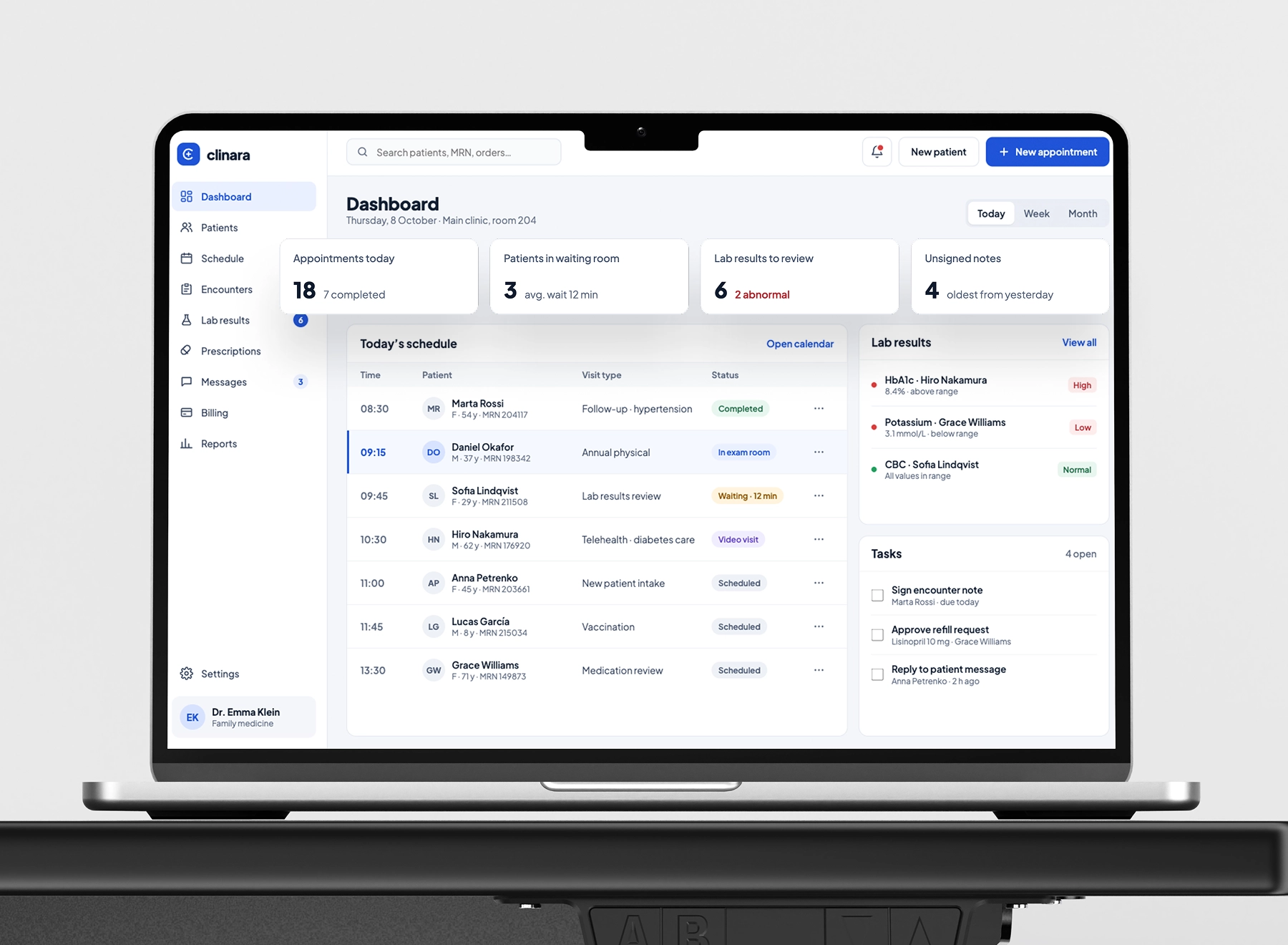
- Viewing medical information on comprehensive dashboards
- Managing clinical tasks with trackers and reminders
- Tracking vaccinations
Patient care delivery and digitalization
- Holding virtual consultations and instant messaging via telemedicine
- Dictating notes and voice commands for doctors, nurses, and administrative staff
- Digitizing handwriting and images for doctors
- Consulting a knowledge base on diseases, drugs, interactions, and treatment protocols
- Getting clinical decision support for prescriptions, diagnoses, treatment options, and dosage calculations
- Sending e-prescriptions
- Monitoring patients remotely via connected medical devices
- Managing chronic diseases with coordinated care plans, patient education, and condition assessment checklists
Patient engagement
- Scheduling visits and receiving appointment reminders
- Using a patient portal and app as a single point of access
- Accessing health records and communicating with providers
- Checking symptoms and getting information support via an AI chatbot and voice assistants
Security and compliance
- Verifying users with multi-factor authentication
- Controlling access with different levels of distributed permissions
- Encrypting data end to end and preventing data leaks
- Transferring data via secure channels and protocols
- Ensuring compliance with HIPAA, GDPR, and other regulations
Health information management and analytics
- Viewing, manipulating, and analyzing medical images in a DICOM viewer
- Analyzing PHI, including lab tests, vitals, and medical images
- Visualizing identified symptomatic patterns
- Modeling scenarios of possible health condition changes
- Reporting on treatment effectiveness
- Analyzing interdepartmental activities, such as the number of referrals
- Sharing data securely between providers via HIE integration
- Storing and managing medical records on blockchain
Revenue, billing, and financial management
- Storing insurance information and specifying payer details
- Managing billing, claims, and the revenue cycle (RCM)
- Analyzing billing process duration, submitted and processed claims, and payer share distribution
- Detecting fraud and managing financial risks with financial analytics
Operational efficiency optimization
- Analyzing visit volume, schedules, and staff workload
- Managing practice operations
- Managing medical inventory
SaaS management (for EHR software products)
- Letting tenants self-register
- Offering an EHR trial period
- Managing users by tenant via user roles
- Billing each tenant
- Customizing the EHR for each tenant
Why Work with IT Craft
- Since 2001 in software development and 20+ years in healthcare software.
- 40+ long-term healthcare projects, including an AI-based clinic staff management system, a HIPAA-compliant legal–medical records platform, and a claims audit solution.
- 330+ specialists, and over 75% of our engineers hold advanced degrees.
- Hands-on work with healthcare interoperability standards and clinical terminologies: HL7 FHIR, HL7 CDA, SMART on FHIR, DICOM, ICD-10, SNOMED CT, LOINC, and RxNorm.
- EHR integrations with Epic, laboratories, pharmacies, PACS, billing systems, and telehealth platforms.
- EHR software built in line with HIPAA, HITECH, GDPR, FDA, MDR, IEC 62304, and NIST CSF, backed by SOC 2, OAuth 2.0, and OpenID Connect security practices.
- A 6-year average cooperation time with clients.
- Clinician-friendly UX/UI design that makes EHR documentation faster and lighter.
Our Services
Since 2001, IT Craft has been providing a full scope of EHR and EMR software development services to power secure PHI management and facilitate billing and treatment. Our healthcare IT experts with 20+ years of experience ensure high EHR usability, interoperability, compliance, and efficiency. We can deliver the entire project or support you at a specific stage.
EHR consulting
Our healthcare IT consultants will:
- Help you choose between an EHR and an EMR.
- Assist with EHR development, implementation, integration, or migration.
- Design an EHR feature set around your care workflows.
- Plan high-level EHR architecture and a tech stack.
- Audit your current EHR or EMR and suggest upgrades for efficiency and compliance.
- Build a business case covering investments and ROI.
- Design a user adoption strategy for clinical staff.
Custom EHR development
Together, we will:
- Design the EHR feature set and UX/UI around your practice.
- Plan scalable software architecture for a user-friendly EHR.
- Build an MVP with core EHR features, then improve it in iterations with QA at each step.
- Integrate the system with the modules and applications you choose.
- Keep the scope within your budget.
- Prepare the EHR for relevant certifications, including ONC certification for the US market.
EHR integration
Our integration engineers will:
- Map data flows between the EHR and the software and devices already in use.
- Connect the EHR through HL7, FHIR, and SMART on FHIR interfaces and choose the integration approach that fits your IT infrastructure: API integrations, middleware, RPA, unified access, or common data services (CDS).
- Link the EHR with laboratories, pharmacies, PACS, and third-party healthcare solutions.
- Set up smooth, secure health data exchange across systems.
EHR implementation
We will:
- Plan the rollout of an out-of-the-box or custom EMR/EHR system.
- Customize the software and handle front-end and back-end development.
- Run change management and installation.
- Follow implementation workflows that reduce common adoption challenges for clinicians.
- Work closely with clinicians, providing training, ongoing support, maintenance, and upgrades.
EHR evolution
We work with you on:
- Analyzing legacy EHR platforms and moving them to modern architectures.
- Migrating records from legacy systems to the updated EHR.
- Designing new EHR features, requirements, and advanced modules.
- UI/UX redesign, code refactoring, and further development.
- Optimizing EHR performance and adding modern healthcare technologies, including AI features.
- Compliance and security audits, followed by improvements.
EHR for Medical Practices vs. EHR for Hospitals
Cohesive health and billing data is convenient, yet many doctors still struggle with EHRs that have an unintuitive UI, lack relevant features, and slow them down with lengthy data entry. When our consultants and EMR software developers design an EHR for a practice or a hospital, they focus on these aspects:
EHR for medical practices
- Holistic medical history for each patient
- Patient access to personal health records via a patient app
- Support for standard services such as appointments, tests, and prescriptions
- Built-in assistance with service coding and billing documentation
EHR for hospitals
- Instant data exchange between hospital departments
- ADT data sharing with patients' medical practices
- Extensive health records storage capacity
- Support for a wide range of services, from consultations to surgeries
EHR and EMR Software We Develop for Different Specialties
IT Craft develops EHR and EMR systems around the specifics of each healthcare organization, so a custom or specialized software improves efficiency, patient care, and user experience. Our healthcare software developers create, tune, and integrate EHR solutions for:
EHRs for solo practitioners
- Primary care practices
- Cardiologists
- Oncologists
- Orthopedic specialists
- Dermatologists
- Ophthalmologists
- Otolaryngologists (ENT)
- Chiropractors
- Geriatricians
- Nutritionists
- OB/GYNs
- Pediatricians
EHRs for medical organizations
- Urgent and emergency care providers
- Diagnostic and radiology centers
- General surgery facilities
- Medical genetics departments
- Rehabilitation facilities
- Nursing and long-term care facilities
- Home healthcare providers
- Behavioral and mental health clinics
- Dental clinics
Choosing the Right EHR Type and Deployment Model
Determining the type of solution and its deployment model early makes the electronic patient records software selection much easier. The right choice depends on your organization's needs, resources, and budget.
Cloud vs On-premise
With cloud-based EHR software, you get a solution that is quicker to implement, comes at a lower upfront cost, and can be accessed outside of the facility. On-premise solutions run without a 24/7 internet connection and offer reliable patient information protection with lower annual fees.
Custom EHR vs Off-the shelf vs Open-source
A plug-and-play commercial EHR works well for healthcare organizations that want a quick setup, need little customization, and are ready to pay an annual fee. Open-source EHR software suits tech-savvy providers looking for a cheaper and more transparent solution. Custom EMR and EHR systems usually require a higher initial investment but combine the best traits of off-the-shelf and open-source EHRs: an intuitive and eye-pleasing interface, high flexibility, and data usage transparency.
EHR/EMR Software Integrations
IT Craft integrates EHR/EMR systems with the internal and external digital solutions your hospital already uses. The goal is a unified medical ecosystem where routine operations run faster, the system is easier to use, and health information exchange flows smoothly between tools. Our team handles both backend and frontend development across different kinds of medical software, so each EHR/EMR integration works at the data level and in the interface clinicians see.
- Financial management systems
- Patient portals
- Laboratory management systems
- Clinical decision support software
- Telehealth apps
- Healthcare CRM
- Medical data analytics
- Medical IoT
- Patient wearables
- Hospital management software
- Pharmacy management software
How to Develop an EHR System in 6 Steps
EHR software development is a team effort that runs from discovery to post-launch support. Our experts deploy EMR/EHR software in on-premise, private, public, or hybrid cloud environments, ensuring scalability and secure personal data management.
-
Discovery stage
You get: an analysis of business needs and clinical workflows (for healthcare organizations) or EHR market, target audience, and competitor research (for product companies), along with a compliance requirements list covering HIPAA, GDPR, ONC, CMS, FDA, MDR, and local regulations. HIPAA-covered entities also receive a Business Associate Agreement, and every client gets an EHR concept, an implementation or marketing strategy, and a business case with TCO and ROI.
-
EHR project planning
You get: a feature list, a software requirements specification (SRS), and a comprehensive EHR design document covering architecture, interoperability logic, integration points, and the tech stack. The package also includes risk assessment and mitigation plans, a project plan with timeframes, milestones, KPIs, and budget, and an EHR certification plan, such as ONC certification for US-targeted solutions.
-
UX and UI design
You get: EHR user scenarios for each role in your healthcare organization, turned first into UX wireframes and then into UI prototypes.
-
Iterative development and testing
You get: a fully functional EHR front end, back end, and APIs for integration with hospital software and third-party tools. Each release comes with a quality report based on functional, performance, security, compliance, compatibility, and accessibility testing.
-
Pre-launch
You get: updated documentation and risk mitigation plans, a HIPAA risk assessment or GDPR compliance audit report, and user training materials. We also help submit the EHR to an ONC-Authorized Testing Laboratory in the US and, for SaMD modules, prepare an FDA 510(k) premarket submission or MDR/IVDR certification by a Notified Body in the EU.
-
EHR launch, support, maintenance, and evolution
You get: secure data migration from legacy records storage and deployment to production after a final readiness check, ensuring the new EHR is launched with minimal disruption. After launch, a help desk and maintenance team monitors system performance and solves operational issues under an SLA, while the EHR keeps evolving based on user feedback and security audits.
Technology Stack
IT Craft continuously expands its collection of tools and technologies to cover clients' unique requests and build cost-effective healthcare solutions. For each EHR, we select the stack that fits its clinical and technical requirements, balancing performance, data security, and interoperability.
Benefits You Get with an EHR Developed by IT Craft
Ease of use
You get EHR software with a human-centric design built around the medical staff's convenience. Doctors and nurses can access the EHR from tablets and smartphones, and performance stays stable.
Interoperability
IT Craft's custom EHRs communicate smoothly with other healthcare IT systems because healthcare data exchange standards such as HL7, FHIR, SMART on FHIR, and DICOM form their core.
Advanced technologies
With IT Craft's expertise in advanced technologies, you can use EHR data analytics for diagnostic assistance, blockchain for secure medical data exchange, and AI for medical image recognition, patient records management, and more.
Regulatory compliance
Every EHR IT Craft develops follows industry security best practices and relevant regulations, including HIPAA, HITECH, and GDPR.
Contributor
-
Healthcare IT Expert & Consultant
Need to design, develop, or improve your software?
Tell us about your project — we'll get back within one business day.