Healthcare Data Analytics Services
Since 2001, IT Craft has been helping providers, payers, and TPAs turn clinical and operational data into healthcare analytics, with high-performance processing and AI readiness built in.
 Overall review rating
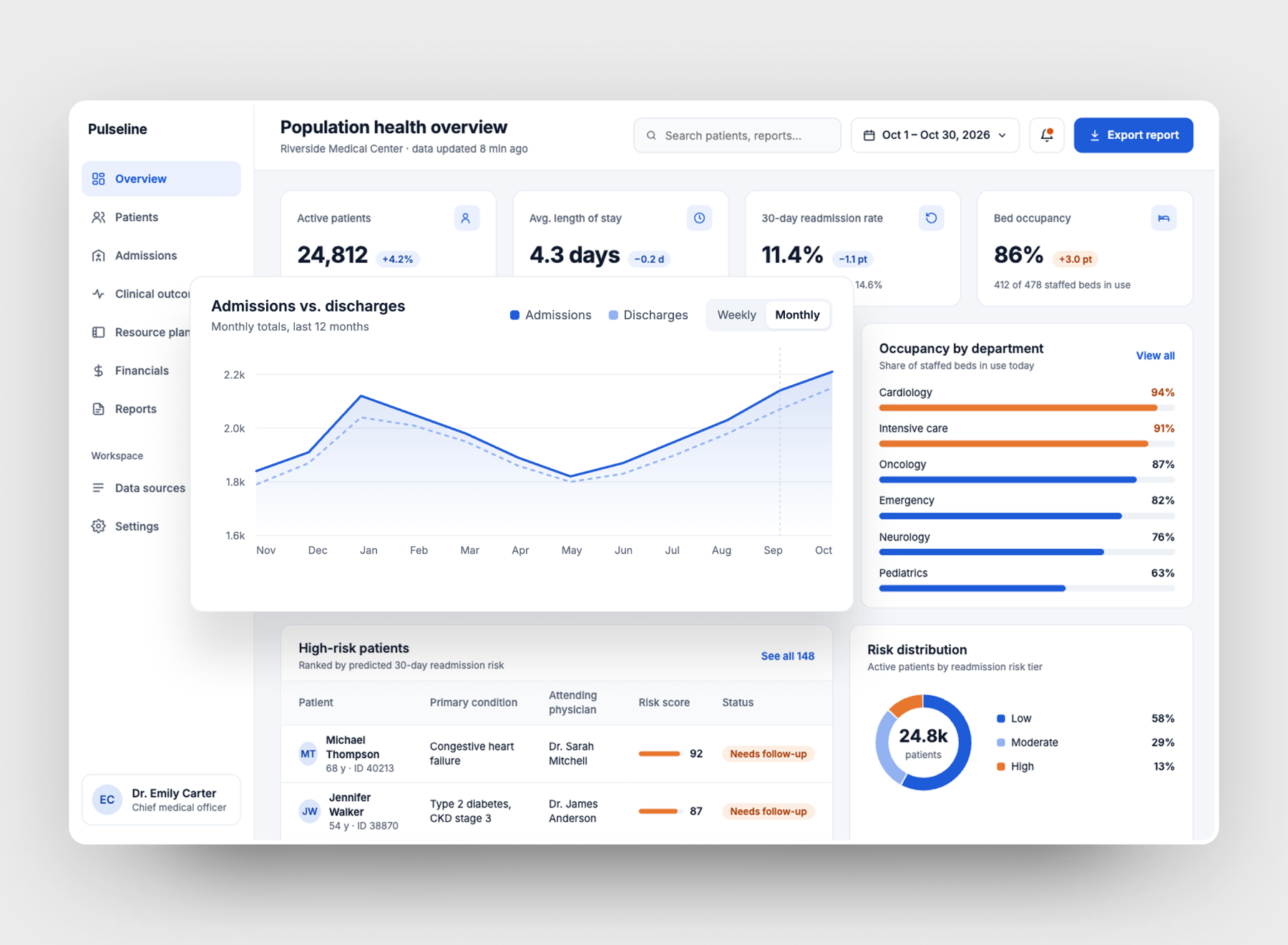
Healthcare data analytics turns current and historical data from legacy systems, cloud sources, and portable devices into insights medical teams can act on. IT Craft builds custom healthcare data analytics solutions, including AI and ML tools, that fit your data landscape and business goals.
Healthcare Data Analytics Challenges and How We Solve Them
Below are the most common challenges our clients face when implementing healthcare data analytics solutions, along with the approaches IT Craft engineers use to overcome them.
| Challenge | Solution | |
|---|---|---|
| Inconsistent Data Formats | Patient data from EHRs, labs, and devices comes in disparate formats, which leads to inconsistent and duplicate values. | Our data engineers turn raw records into standardized datasets through data cleansing, normalization, and validation. |
| Limited Interoperability | Data exchange between disconnected systems is often limited by different terminologies and interfaces. | We sets up EHR and HIE integration with terminology mapping. For systems without standard interfaces, custom APIs are developed. |
| Growing Data Volumes | A platform designed for a single facility may not withstand growing imaging, device, and claims data, so scalability should be planned from the start. | Our architects design scalable platforms with distributed storage and automated processing for high-load environments. |
| Slow Data Access | It may be hard to act on time when analytics depends on batch exports and manual reports. | In addition to data warehouses and ETL processes, IT Craft sets up real-time streaming and event-driven pipelines that keep data up to date. |
| Unreliable Analytics Results | Reports built on fragmented sources are associated with the risk of conflicting numbers across dashboards. | We add validation layers and build trusted pipelines that feed centralized analytics, creating a single source of truth. |
| Data Governance Gaps | Data quality and protection cannot be ensured once and for all, as new sources, users, and reports keep appearing. | IT Craft helps define a governance strategy and trains personnel. If needed, we can take over ongoing data quality monitoring. |
| Data Not Ready for AI | For organizations planning AI initiatives, scattered and incomplete data is the main blocker. It is crucial to prepare it before AI models go live. | Our engineers prepare structured datasets through data cleansing and improve data accessibility, so AI models and predictive analytics get reliable input. |
| Analytics That Require Technical Skills | Clinical staff and operational teams may wait days for a report, especially when every request goes through the data team. | We build self-service BI, from accessible dashboards to reporting tools that clinicians and managers use on their own. |
Costs & Timelines
Based on industry benchmarks, the cost of healthcare data analytics implementation may range from $100,000 to $1,250,000+, depending on data complexity and volume, the number of data sources, as well as security and compliance requirements.
| Solution Scope / Analytics Type | Typical Cost Range | Estimated Timeline |
|---|---|---|
| Basic Reporting and Dashboards | $100,000–$250,000 | 3–5 months |
| Mid-Complex Analytics Platform | $250,000–$500,000 | 6–9 months |
| Enterprise / Predictive Analytics | $500,000–$1,250,000+ | 9–12+ months |
Core Cost and Timeline Drivers
Major factors that affect the analytics budget and timelines are:
- The required regulatory compliance (HIPAA, Medicaid, SAMHSA rules, etc.).
- The number and quality of data sources (e.g., EHR, claims, labs), including approvals for data extraction.
- The volume of data cleansing and standardization.
- The level of analytics sophistication (standard dashboards vs. real-time predictive models).
- Ongoing expenses for data warehousing and BI tool subscriptions, third-party licenses, and clinician training.
- (for outsourced development) A vendor’s service pricing model.
Healthcare Data Analytics Solutions We Deliver
Big Data Analytics
We create big data analytics solutions that process multiple data sources to support tailored treatment plans, condition management, and timely prevention, as well as detect fraud.
Image Analysis
Our experts train and implement machine learning models that analyze medical images with higher diagnostic precision, reducing patient exposure to repeated scans.
IoMT Analytics
We deliver ML-powered solutions that collect real-time device data from IoT healthcare applications, recognize medical condition patterns, and detect condition changes.
Business Analytics
IT Craft’s team implements custom analytics that tracks personnel performance and resource utilization, as well as staff allocation and patient throughput. It also helps improve operational efficiency.
Clinical Analytics
We build clinical analytics solutions that track treatment outcomes, identify care gaps, and assess protocol adherence to support evidence-based medical decisions.
Financial Analytics
Our team develops financial analytics tools that analyze reimbursement patterns, detect revenue leakage, and improve revenue cycle performance and financial forecasting.
Data Warehousing
We create secure storage for protected health information from multiple healthcare systems and take care of data structuring and standardization.
Predictive Analytics
We deliver ML-based solutions that estimate probable outcomes, like condition development or supply chain interruptions, and help healthcare organizations make informed decisions.
Data Visualization
We implement solutions that turn medical metrics into intuitive dashboards, showing real-time personnel and facility performance as well as patient health trends.
Population Health Analytics
We develop solutions that analyze research and demographic data, including cohort health patterns and longitudinal studies, to support patient stratification and real-world evidence generation.
AI-Powered Analytics
Our engineers build AI-powered analytics solutions that detect trends, create predictive models, and deliver insights automatically using LLMs and machine learning pipelines.
Quality Reporting
IT Craft implements quality reporting solutions that track CMS, HEDIS, and custom quality indicators to help healthcare organizations meet compliance requirements.
Types of Healthcare Data We Work With
Administrative Data
- Patient demographics and contact details
- Healthcare professionals
- Clinic and hospital profiles
- Locations
- Service catalogs and price lists
Clinical Records
- Medical conditions and diagnoses
- Allergies and immunizations
- Procedures performed
- Hospital visits
- Care plans and treatment goals
- Risk assessments
Diagnostic Data
- Laboratory test results
- Medical imaging (X-ray, CT, MRI)
- Vital signs
- Clinical observations and notes
- Diagnostic reports
Medication Records
- Prescriptions and refills
- Medication intake history
- Pharmacy dispensing records
Financial and Insurance Data
- Insurance coverage and eligibility
- Claims and billing documents
- Payment transactions and remittances
Workflow Data
- Appointments and scheduling
- Referrals between providers
- Task management and care coordination
Clinical Decision Support Data
- Clinical guidelines and rules
- Quality metrics (eCQM)
- Decision support logic and alerts
Medication Reference
- Drug catalogs and product definitions
- Packaging and labeling information
- Regulatory approvals and authorizations
Healthcare Data Standards We Support
FHIR-Based Data Exchange
To make healthcare data exchange fast and secure, IT Craft builds FHIR-first platforms and servers for real-time, API-based integration of clinical systems. Our team has hands-on experience in designing FHIR architectures, implementing FHIR servers, and connecting them with existing clinical systems.
We use FHIR together with CQL and medical terminologies (ICD-10, LOINC, SNOMED CT, RxNorm) to support data management, clinical decision support, and interoperability that meets ONC/CMS requirements and the IPS framework.
Specialized and Legacy Data Standards
- HL7 v2/v3 — Keeps messaging compatible with legacy healthcare systems that are still in use.
- OpenEHR — Vendor-neutral standard for building structured health records.
- CDA (Clinical Document Architecture) — Supports document-based exchange between healthcare providers.
- DICOM — Standard for storing and sharing medical imaging data across healthcare systems and devices.
- X12 — Widely used for financial transactions, billing, and insurance data.
- JSON / XML — Provide structured data formats for modern APIs and interoperability.
Healthcare Data Analytics Services We Offer
Data Architecture Design
We design scalable data architectures for data integration, processing, and management, with reliable data flows between systems.
Data and Analytics Platform Engineering
Our engineers build FHIR servers, data warehouses, and lakehouses, with analytical and semantic layers ready for AI-powered workloads.
Healthcare Data Mapping
Our data engineers perform terminology and structure mapping and automate data transformation between FHIR, HL7 v2, CDA, X12, and proprietary formats.
HL7 Interface Development
We develop interfaces for legacy HL7 v2 messaging and FHIR APIs, enabling real-time data exchange and interoperability between clinical applications.
Dashboard and Reporting Development
IT Craft builds clinical research dashboards, operational monitoring tools, and regulatory reports, as well as self-service BI that makes insights accessible to everyone.
DataOps and Pipeline Automation
We automate healthcare data pipelines, from data ingestion and validation to transformation and delivery.
FHIR Implementation
For legacy systems, we build FHIR facades and integration layers and set up data exchange workflows according to implementation guides.
Healthcare Data Modeling
Our team designs comprehensive data structures that improve data clarity, accessibility, and cross-system consistency for decision-making.
Data Quality Assurance
IT Craft sets up automated validation, standardization, and deduplication, along with data profiling, EMPI, terminology alignment, and ongoing monitoring.
ELT Pipeline Development
We extract EHR, HIE, and claims data, both structured and unstructured, and run data validation and terminology mapping to produce analytics-ready datasets.
Healthcare Data Security and Privacy
Our engineers implement attribute-based access control, encryption, audit trails, and OAuth 2.0/OpenID Connect to support HIPAA and GDPR compliance.
AI and ML Development
We develop LLM-powered tools for smart data search, automated reporting, clinical insight generation, and conversational interfaces.
Data Management Training
Our experts run training programs that build your team’s data management skills, so your staff use data effectively and work more productively.
Healthcare System Integration
IT Craft connects EHRs and HIEs, billing platforms, medical devices, and patient apps through centralized platforms, APIs, and event-driven workflows and pipelines.
Medical Data Analytics Use Cases
Disease Course Prediction
Analyzing EHR data, patient surveys, and readings from RPM devices helps estimate disease risks. Clinicians can then plan early intervention.
Treatment Planning
Comparing patient profiles with treatment models shows likely treatment effects and safety risks. This supports personalized care.
Chronic Condition Management
Condition profiling and continuous monitoring track condition progression. The system sends complication alerts and management recommendations.
Self-Harm Prevention
Monitoring mental state and analyzing behavioral health data help detect signs of anxiety and depression. Early risk identification lets care teams step in sooner.
Resource Allocation
Studying resource usage patterns, scheduled appointments, and epidemiological conditions helps predict demand. Resources can then be redistributed in advance.
Patient Load Management
Patient flow modeling forecasts facility and specialist demand. Hospitals can prepare for a patient influx and prevent disruptions.
Supply Chain Management
Analytics supports order placement and price negotiation by comparing product variability, equipment suppliers, and vendor agreements.
Fraud Prevention
Checking insurance claims against patient histories reveals unnecessary services, duplicate billing, and phantom billing.
Patient Engagement
Analyzing patient behavior and care preferences helps offer tailored services and keep communication transparent.
Data Security
ML-based modeling detects suspicious access patterns and data sharing anomalies. This lowers security risks in data utilization.
Our Engagement Options
Consulting
We help you choose the technical architecture, data models, and integration approaches for a future-ready data platform.
Implementation
IT Craft implements cloud-native healthcare platforms such as AWS HealthLake and BI tools like Tableau, Power BI, and Looker. We configure the infrastructure and adapt the solution to your business workflows.
Custom Data and Analytics Development
Our team develops custom solutions for data storage, data quality management, integration, analytics, and AI-driven tools.
Migration
We move data from legacy systems and EHRs to cloud platforms, including large-scale migration, and deliver analytics-ready data at the end.
Modernization
Legacy application upgrades and re-engineering with performance optimization, functionality improvements, and security updates.
Regulatory Compliance
We build FHIR-native solutions with API-driven access, patient data sharing, and secure workflows in line with ONC, CMS, IPS, ISiK, and MedMij requirements.
Healthcare Analytics Delivery Models
Custom Solutions
We start with business and technical research and then build bespoke analytics software with tailored functionality and integration into your infrastructure.
Embedded BI
Analytical modules are built into your existing healthcare software, giving the whole organization access to integrated reporting.
Platform Customization
IT Craft customizes Microsoft Cloud for Healthcare, AWS HealthLake, Power BI, Tableau, Qlik, and Looker to your needs.
Data-Driven Healthcare Systems We Develop
HIE
Secure data exchange between healthcare providers for better care coordination.
EHR
Secure storage of patient records and health history, built around clinical workflows.
CDSS
Clinical decision support with data-driven insights and real-time alerts that improve patient safety.
Clinical Data Repository
Centralized clinical information with secure storage, data management, and data access.
Benefits of Medical Data Analytics
Earlier Diagnosis and Disease Prevention
Early risk identification that leads to fewer hospitalizations, less pressure on ERs and ICUs, and faster patient recovery.
More Personalized and Effective Care
Individualized treatment based on patient needs, with higher treatment success, patient satisfaction, and more inclusive care.
Improved Operational Efficiency
Fewer redundant workflows and better use of resources and personnel, making operations more cost-effective and freeing capacity to expand the patient base.
Improved Crisis Management
Preparedness for epidemics, personnel shortages, and overcrowding, with timely resource redistribution to maintain operational continuity.
Accelerated Drug Discovery and Rollout
Big data modeling of clinical trial data that speeds up pharmaceutical research, lowers processing costs, and helps confirm drug safety sooner.
Our Approach
-
Careful Planning and Design
We start with your business goals and data readiness. After a technical assessment, our experts design the architecture and select technologies that fit them.
-
Transparent Implementation
Development stays transparent at every stage. When requirements evolve, you see the impact on delivery timelines and keep the budget under control.
-
Collaborative Partnerships
Our healthcare expertise and your knowledge of the business come together in co-development. This is how we deliver large-scale solutions that meet compliance and performance requirements.
-
Ongoing Optimization
After launch, we keep improving the solution in iterations, with testing for reliability and scalability, and provide long-term support.
Technology Stack
Why IT Craft
- Since 2001 in IT and 20+ years in healthcare software development.
- 330+ experts on board, including business analysts, data engineers, and architects.
- 2,250+ projects delivered and a 6-year average cooperation time with clients.
- Understanding of clinical workflows, payer operations, and healthcare regulations.
- Working experience with HIPAA, HITECH, and GDPR requirements.
- Interoperability expertise: HL7 FHIR, HL7 v2, CDA, DICOM, ICD-10, LOINC, SNOMED CT.
- Data integration, quality management, and visualization for reliable reporting and cost analysis.
- AI-ready data infrastructure for predictive analytics, clinical decision support, and population health management.
- Encryption, access controls, identity management, and audit logging in every solution.
- End-to-end services, from consulting and implementation to data migration, modernization, and support.
FAQ
It is automated data analysis based on artificial intelligence, machine learning, and sometimes blockchain. Unlike traditional business intelligence, it helps predict health outcomes and operational trends.
The most common ones are linear and logistic regression, classification and regression trees, K-nearest neighbors, and K-means clustering.
Yes, of course. We can assess your data flows, data quality, governance, and interoperability before development starts to give you a practical roadmap from the very first sprint.
We build FHIR-based integration layers with terminology mapping, so data from all systems uses the same codes. Claims feeds are connected the same way, and duplicate records and inconsistent formats are cleaned up during integration.
Sure! We set up streaming pipelines and event-driven processing for real-time analytics and ELT for batch loads, with agreed SLAs and scale testing before launch.
We use three methods. With Safe Harbor, our engineers remove 18 types of identifiers defined by HIPAA. Expert Determination assesses re-identification risk statistically and keeps more data usable for research. Pseudonymization adds a way to keep records linked across datasets without revealing patient identity.
Data privacy is part of every stage of our healthcare analytics projects. At the analysis stage, our business analysts identify all regulations relevant to your data, e.g., HIPAA and GDPR, and translate them into specific security requirements. During development, we implement attribute-based access control, encryption, audit trails, and OAuth 2.0/OpenID Connect authentication. Before the release, we conduct a security audit. After launch, we provide ongoing monitoring and testing to keep the solution in line with regulatory updates.
Yes. We develop risk stratification, readmission prediction, chronic disease progression, and care gap identification models trained on the data of the population you serve.
Sure! We build executive population health views, care coordinator tools, and clinical performance dashboards for quality teams, and add new ones as your reporting needs grow.
Contributor
-
Healthcare IT Expert & Consultant