Healthcare IoT Solutions
Healthcare IoT solutions facilitate patient health monitoring and medical staff and asset tracking through a network of cloud-connected smart devices and sensors. Rated 4.9 on Clutch, IT Craft is ready to help you establish cost-effective connected care and integrate IoMT innovations into your clinical workflows.
 Overall review rating
IoT Adoption in Healthcare
In parallel Deloitte surveys of 50 medtech leaders and 50 health care executives, conducted in December 2024 and January 2025, 84% of providers rated the clinical value of connected care hardware, connected care software, and services as substantial to considerable, and 74% said the same about operational value.
96% of medtech respondents named connected care a key focus area, and half of them expect it to make up most of their portfolio within five years.
Medtech vendors and the providers who use their devices do not name the same obstacles, so the survey shows a clear mismatch in how adoption challenges are perceived.
Medtech executives put the lack of EHR interoperability first (45%), followed by data privacy and security (32%) and workflow integration with existing processes (31%).
Providers rank their issues differently, with demonstrating end-user value at the top (32%), then workflow integration (29%) and budget constraints (27%).
The key drivers of IoT adoption in healthcare
- The COVID-19 pandemic hit hospitals with staff shortages and patient flow surges, along with other pressures on clinical teams.
- Providers look for healthcare cost reduction through routine task automation, such as monitoring patients’ health parameters, and more efficient day-to-day operations.
- Care teams shift toward active patient engagement and personalized care, as patients increasingly expect a personalized approach to their treatment.
Cost and Timelines
The cost of healthcare IoT (IoMT) implementation typically ranges from $45,000 to $1,000,000+, with a timeline of 3 months to 2+ years.
Cost Breakdown by Solution Scale
Most of the price gap comes from the solution scale. Here are sample price ranges for four tiers:
| Solution Scale & Tier | Estimated Cost Range |
|---|---|
| Off-the-Shelf RPM Pilot | $45,000 – $150,000 |
| Hybrid IoMT Platform | $100,000 – $300,000 |
| Custom Mid-Level IoMT Solution | $300,000 – $500,000+ |
| Enterprise IoMT Infrastructure | $1,000,000+ |
Key Cost Factors in Healthcare IoT (IoMT)
The cost of an IoMT solution varies a lot and depends on multiple factors. Below, IT Craft’s healthcare IoT experts list the top 7 cost drivers, with the first three moving the price the most:
- Regulatory compliance requirements (e.g., HIPAA, GDPR), incl. data encryption and access control.
- Medical device certification (e.g., FDA, CE Mark, ISO 13485) if the solution counts as SaMD.
- The hardware path: ready-made medical devices or custom sensors (the latter can add 50,000–250,000+ to the budget).
- Integrations with hospital systems (e.g., EHR, EMR, lab systems).
- Solution complexity (its functionality scope).
- Data processing approach (cloud, edge, or both).
- The number of connected devices and patients.
*The final budget and timeline depend on the solution’s complexity, compliance requirements, and integration scope.
Challenges and Solutions
Below are the most common challenges our clients face when implementing Healthcare IoT solutions, along with the approaches IT Craft engineers use to overcome them.
-
“Our IoT devices collect patient vitals, but we can’t get that data into Epic or Cerner.”
Our team connects medical IoT devices and remote monitoring platforms with EHR/EMR systems via HL7 and FHIR. For systems without standard interfaces, custom healthcare APIs are developed.
-
“We’re collecting sensitive patient data. How do we keep it secure and HIPAA-compliant?”
Our engineers implement PHI safeguards at every level of the IoT system, from encrypted data storage and transmission and secure device authentication to role-based access and audit trails.
-
“We need real-time patient monitoring, but delayed data and missed alerts put patients at risk.”
IT Craft experts stream device readings over MQTT for near-instant dashboard updates and set alert thresholds for each patient. Unacknowledged alerts escalate to the next care team member, and silent devices are flagged automatically.
-
“Our devices drop connection in hospital basements, rural areas and patients’ homes.”
Readings are buffered locally on the device and synced automatically once the connection is back. Depending on the location, our engineers combine BLE, Wi-Fi, LTE-M/NB-IoT, and 5G.
-
“We have a limited budget, but we can’t afford to invest in an IoT system that won’t scale.”
IT Craft starts with a focused IoT MVP and builds a modular architecture that can grow with the number of devices and patients. If needed, new features are added in phases, without expensive system rebuilds.
Architecture of IoMT in Healthcare
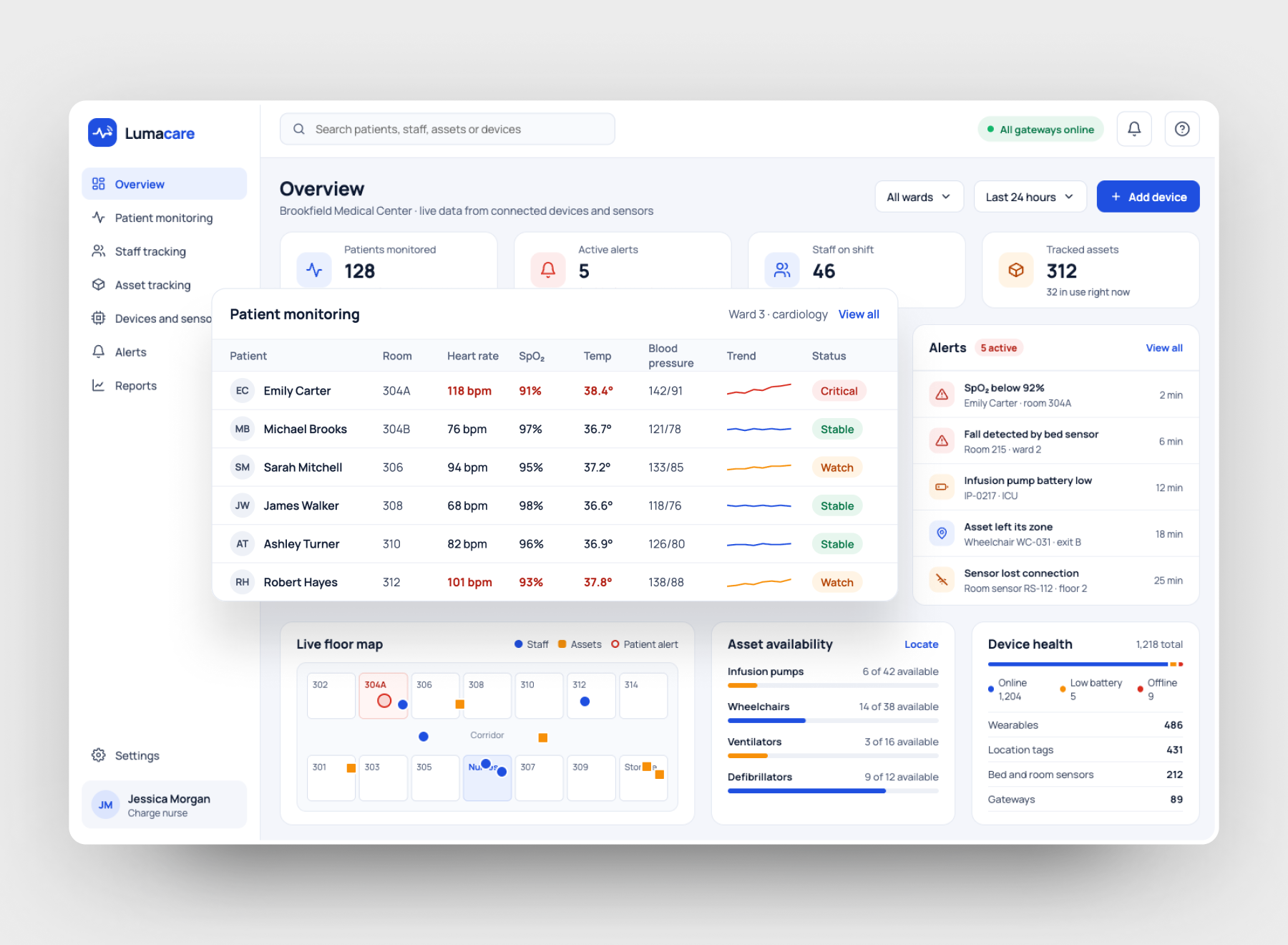
A typical IoMT solution links connected medical devices (e.g., wearable biosensors and smart monitors for remote patient care, RFID tags and readers for asset and staff tracking) through IoT gateways to a central cloud.
The cloud server and data analytics layer stores and processes incoming readings, runs the solution’s business logic, and hosts the apps that control devices. Through user/admin applications, patients, clinicians, and hospital staff review collected data and analytics results, adjust device settings (e.g., change the temperature in a ward), and more.
Healthcare IoT Solutions for Connected Care
IT Craft applies its healthcare IT expertise to build IoMT solutions that create a secure healthcare environment for patients and medical teams. With established project management practices, we keep each project on track within agreed time and budget constraints.
Remote Patient Monitoring
Remote patient monitoring (RPM) solutions support continuous health data collection (e.g., heart rate, blood glucose, weight) and analysis, early symptom detection and alerts for patients and care teams when health parameters go out of range, and more. This improves chronic care and clinical decision-making, makes care more accessible between visits, and keeps patients engaged in their treatment.
How IoT-enabled remote patient monitoring works: Connected medical devices (e.g., blood pressure cuffs, pulse oximeters, ECG patches) or wearable biosensors measure health parameters and transfer them to the cloud, where cloud-based health data is stored and analyzed. If a reading rises above or drops below the limits set by the doctor, both the doctor and the patient receive a notification. IT Craft builds IoMT platforms that link medical devices for real-time monitoring and alerts and secure data exchange.
Use cases:
- Chronic disease monitoring for patients with heart failure, hypertension, diabetes, COPD, and other conditions.
- Post-surgery outpatient monitoring.
- Advanced analytics for early diagnostics (e.g., detecting signs of arrhythmia or prediabetes).
- Diagnostic and disease progression analytics to identify possible complications.
- Medication adherence monitoring (e.g., with smart pill dispensers for elderly patients, connected pill bottles).
- Rehabilitation progress tracking.
Hospital Asset Tracking
Hospital asset tracking solutions show asset location and availability at any moment, support asset utilization management and smarter equipment purchases, and cut the time staff spend on medical supplies and medication tracking.
How it works: Each asset (e.g., infusion pumps, wheelchairs, surgical kits) gets an RFID tag. RFID tags and readers installed in hallways, storage rooms, and doorways register every movement and send the data to a cloud server. Staff see real-time asset location on a hospital floor map or find the nearest available item through search.
Use cases:
- Medication inventory tracking.
- Hospital equipment utilization monitoring (e.g., ventilators, portable X-ray units).
- Unauthorized asset use prevention.
Patient and Medical Staff Tracking
Patient and staff location tracking improves hospital security, reveals gaps in staffing and scheduling optimization (e.g., too few nurses on a night shift), and supports faster bed allocation.
How it works: Patients and employees wear RFID bracelets that store data for patient and staff identification (e.g., ID, role, EHR reference). Readers on walls and ceilings provide real-time location tracking and forward each signal for cloud-based data processing and analysis.
Use cases:
- Patient and staff safety in wards and emergency departments.
- Wandering and flight-risk prevention for patients with dementia or disorientation.
- Newborn security in maternity units.
- Patient flow optimization.
- Staff scheduling and workflow bottleneck detection.
Smart Hospital Solutions
Smart hospital solutions cover room environment monitoring, hospital security (e.g., detecting unauthorized access to a lab), and energy and water consumption optimization. They also help with ward condition management, keeping rooms comfortable for patient recovery.
How it works: Motion and temperature sensors feed room condition monitoring, and the system responds with predefined IoT actions. For example, lights switch on when someone enters a ward, and automated lighting and climate control turns on air conditioning once the temperature rises above the set level.
Use cases:
- Climate control (e.g., lower temperature in empty wards, humidity adjustment).
- Smart room lighting with connected switches and door or window contacts.
- Energy efficiency monitoring.
- Hospital security monitoring.
Remote Care Delivery and Patient Self-Management
Remote care delivery solutions serve mainly patients who need chronic disease management. They make home-based treatment possible and support secure clinical decision-making without a doctor present at every step.
How it works: Connected medical devices and sensors send patient health data to the IoMT solution. Based on this data, the solution performs medication dose calculation and, when needed, starts treatment delivery (e.g., an insulin dose via a connected pump).
Use cases:
- Diabetes management with continuous glucose monitoring, smart insulin pumps, or closed-loop systems.
- IoT-based spirometer therapy for patients with COPD.
Wellness-Tracking Wearables
Smart wearables for health and fitness tracking give people more control over their well-being. These devices allow remote vital sign monitoring and collect health statistics that both patients and doctors can use. Patients get a clearer picture of their daily habits, and providers receive data to support treatment decisions and patient self-management.
Use cases:
- Fitness tracking and activity goal setting.
- Chronic disease monitoring outside the clinic.
- Preventive health monitoring (e.g., sleep, stress, heart rhythm).
- Patient self-management support for people with hypertension or diabetes.
Secure Healthcare Data Collection
Healthcare organizations can collect and transmit medical data quickly without putting patient data privacy at risk. With 5G connectivity, large files such as diagnostic images move between doctors and hospitals much faster than over older wired networks. As a result, care teams can make diagnoses and start treatment sooner.
Use cases:
- Remote diagnostics.
- Medical imaging transfer (e.g., CT and MRI scans between facilities).
- Real-time patient monitoring in ambulances.
- Doctor-to-hospital data exchange.
Benefits of Healthcare IoT Solutions
- New opportunities for outpatient care and chronic disease control with the help of remote patient monitoring and outcomes analytics.
- Asset utilization and investment optimization based on data about how equipment is actually used in the hospital.
- Improved patient safety.
- Lower risk of equipment failure due to predictive maintenance.
- Reduced nurse workload due to workflow automation (e.g., vital signs measurement, equipment disinfection scheduling).
- For health systems with several sites: facility visibility from headquarters into the state of remote clinics.
- Tracking of movable devices and better visibility into how often each one is used.
Healthcare IoT Development Services
Since 2001 in healthcare IT consulting and development, with solid IoT expertise and a team of 330 engineers on board, IT Craft is ready to bring your medical IoT projects to life.
Consulting
What we do:
- Identify and analyze your medical IoT needs as part of the IoMT needs assessment.
- Outline the future IoMT software in software functionality planning.
- Create a high-level design for API and healthcare system integrations (with EHR, CRM, lab systems, etc.).
- Design custom IoMT software with a flexible architecture, so you can add new features when needed.
- Estimate the cost, ROI, and delivery timelines.
- Compliance and ROI roadmap (e.g., for HIPAA, HITECH regulations).
Development
What we do:
- Shape IoMT product conceptualization based on high-level or detailed requirements.
- Prepare a complete list of healthcare IoT software features.
- Plan a scalable software architecture with a focus on flexibility.
- Deliver MVP development with priority features and roll out the rest on an agreed schedule.
- Ensure regulatory compliance and maintenance in line with required regulations (HIPAA, HITECH, etc.).
- Support and update the software.
Why Choose IT Craft Company for Your Healthcare IoT Solutions
Deep healthcare and IoT expertise
20+ years in healthcare software and since 2001 in IT, with projects like Workforce.AI for Aya Healthcare.
Medical IoT expertise beyond device connectivity
Hands-on experience with IoMT solutions that combine sensors, applications, cloud infrastructure, analytics, and clinical workflows.
Healthcare regulatory and quality expertise
Expertise with HIPAA, HITECH, FDA, and GDPR requirements, including software that falls under SaMD rules.
Strong interoperability capabilities
EHR, EMR, and HIS integrations via HL7 and FHIR, with support for ICD-10, CPT, SNOMED CT, LOINC, and RxNorm.
End-to-end IoT development
Full IoMT lifecycle coverage, from business and technology consulting to MVP development, integrations, analytics, compliance, and ongoing support.
Security and scalability
IoT engineering backed by cybersecurity, cloud technologies, data engineering, and analytics expertise.
Proven healthcare delivery capabilities
330+ experts on board, including business analysts, regulatory consultants, architects, and engineers. 2,250+ projects delivered and a 4.9 Clutch rating.
Contributor
-
Healthcare IT Expert & Consultant