Virtual Reality (VR) In Healthcare
Since 2001, IT Craft has been developing healthcare software and now provides end-to-end VR consulting and development for hospitals, medtech companies, and medical education providers.
 Overall review rating
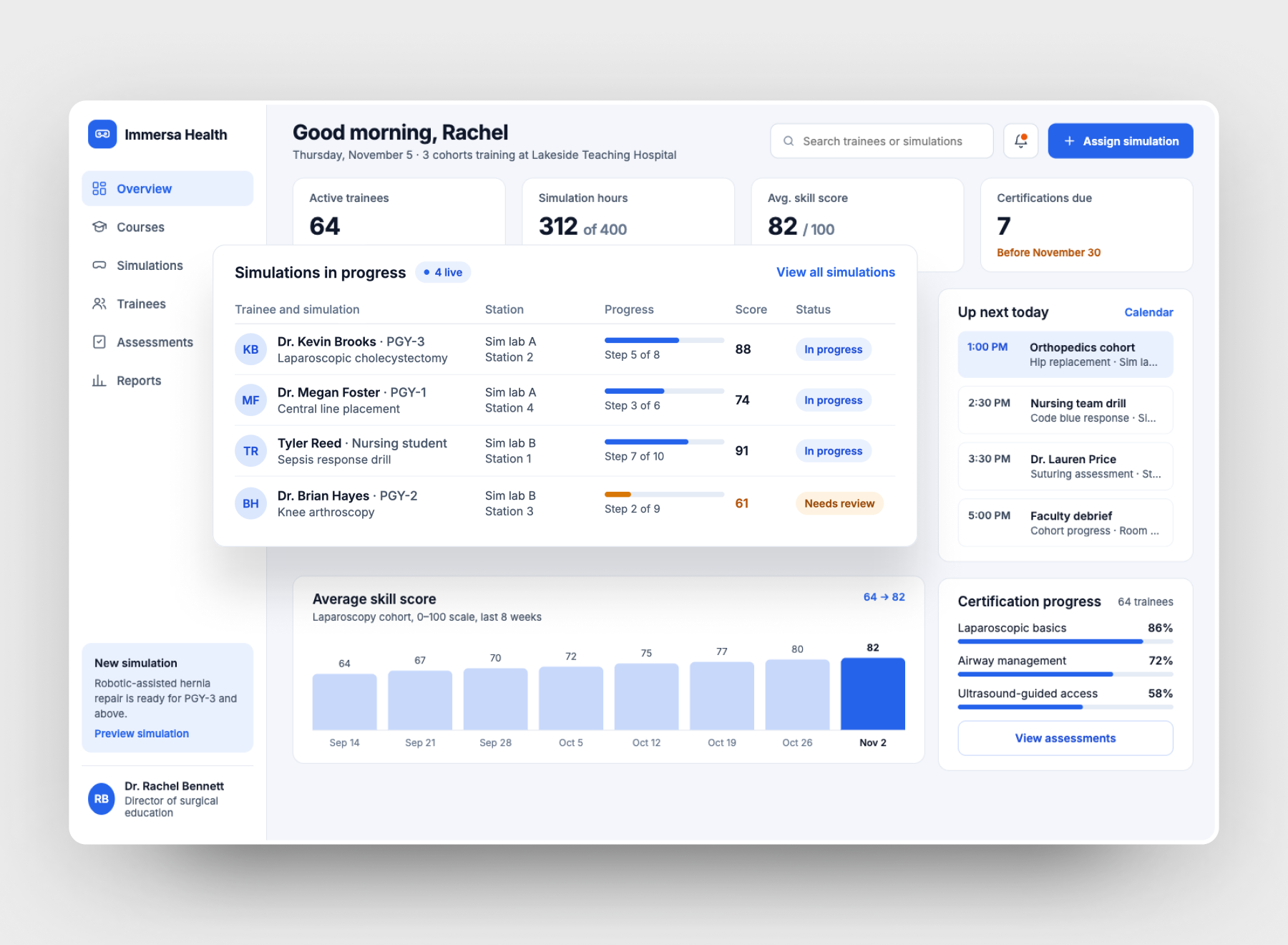
Virtual reality solutions help healthcare professionals and patients train, treat, and recover in simulated environments, from medical education and surgical practice to rehabilitation and pain management. IT Craft’s VR engineers can build your healthcare VR app according to HIPAA requirements to integrate it with your EHR and hardware and deliver realistic 3D experiences for your hospital, clinic, or medical school.
Adoption of Virtual Reality in Healthcare
A Virti survey of 211 US healthcare workers responsible for training tools found that 34% of their organizations had already implemented VR and another 43% planned to do so.
According to Accenture, 82% of healthcare professionals agree that VR is a convenient way for medical students and practicing clinicians to access and learn information. The agency also reports that 62% of patients would welcome VR-based services as an alternative to traditional care.
The global VR in healthcare market reached $5.81 billion in 2024 and is expected to hit $45.79 billion by 2033, growing at a 27.5% CAGR (DataM Intelligence).
The key drivers of VR adoption in healthcare are:
- Growing demand for quality healthcare services.
- Pressure to reduce healthcare costs.
- The expanding role of connected devices (e.g., wearables, remote monitoring sensors) in care delivery.
Challenges & Solutions
Below are the most common challenges our clients face when developing healthcare VR solutions, along with the approaches IT Craft engineers use to overcome them.
-
“Our VR product handles patient data, and it has to pass HIPAA review.”
We build compliance into the product from day one: HIPAA-ready backends, encrypted session and biometric data, de-identified analytics, and audit trails. For therapeutic VR, our team also prepares IEC 62304 and FDA/MDR-ready documentation for regulators, hospital IT security reviews, and investors.
-
“We need to connect this VR app to our EHR, PACS, and tracking hardware — and nobody can do it.”
IT Craft engineers pull MRI and CT scans into VR via PACS, sync simulation results back to Epic or Cerner through FHIR APIs, and connect specialized hardware such as haptic gloves.
-
“Surgeons and patients will be using this. We can’t afford lag, bugs, or motion sickness.”
We optimize every build for a stable 90+ FPS, check anatomy models for medical accuracy, and run user testing with the target audience before each release.
-
“Our VR concept looks impressive, but we don't know if it will work in a real clinical setting.”
Our team designs VR experiences around real clinical workflows, from surgical simulations and medical training to pain management and patient education. We involve clinicians early, test usability with clinical staff, and agree on measurable outcomes before development scales.
Costs & Timelines
Based on IT Craft’s healthcare software projects and industry benchmarks, the cost of custom healthcare VR app development may range from $50,000 to $1,500,000+, depending on app scale and complexity, the number of integrations, as well as security and compliance requirements.
| Project Scope / VR App Type | Typical Cost Range | Estimated Timeline |
|---|---|---|
| Basic / MVP VR App | $50,000–$150,000 | 2–4 months |
| Mid-Complex VR App | $150,000–$400,000 | 4–8 months |
| Enterprise VR Platform | $500,000–$1,500,000+ | 12–24+ months |
Core Cost and Timeline Drivers
Major factors that affect the development budget and timelines are:
- The required regulatory compliance (HIPAA, GDPR, etc.).
- The number and complexity of integrations with EHR/EMR systems (e.g., Epic, Oracle Health), PACS, and telehealth tools.
- The number of user roles and access levels.
- The volume of legacy patient and medical imaging data migration.
- The required platform scope (VR headsets, web admin panel, native iOS and Android apps).
- (for outsourced development) A vendor’s service pricing model.
Healthcare VR Software Architecture
The architecture of VR applications depends on the use case, but most healthcare solutions include three components:
- Client VR application with a visualization module that renders 3D scenes on the headset.
- Database that stores 3D models, training scenarios, and user data (incl. session results).
- Web administration panel where admins, tutors, or therapists manage app content, users, and the database.
Types of VR Solutions for Healthcare
For Medical Education
Medical students explore interactive 3D medical models and practice patient communication with AI-controlled virtual patients, which brings theoretical learning closer to clinical practice.
How it works
Learners join individual sessions or group sessions. A real tutor or an AI-controlled virtual tutor leads the session, explains the material, and answers questions.
Use cases
- Anatomy learning.
- Medical social skills learning (e.g., taking a patient history, delivering bad news).
For Clinical Training
VR training lets medical graduates and healthcare professionals build hands-on skills through risk-free practice in simulated medical scenarios.
How it works
The trainee moves through a simulated environment by predetermined steps. The app runs action recording, and an analytical module compares each action with the protocol for performance assessment.
Use cases
- Medical procedure simulation.
- Emergency case simulation.
- Medical equipment training.
For Surgery
Surgeons rehearse mock surgeries and sharpen practical surgical skills through virtual practice instead of sessions on training mannequins.
How it works
With haptic controllers in hand, a surgeon operates in a virtual operating room and follows guided surgical steps. The app checks the action sequence and can replay the procedure for patient explanations before the actual surgery.
Use cases
- Surgical training.
- Pre-surgical planning.
- Medical device marketing (e.g., demos of new surgical instruments).
For Pain Management
VR helps patients cope with pain and extreme discomfort through attention diversion, which may lead to reduced painkiller use and lower healthcare costs.
How it works
An immersive simulation draws the patient into a gamified experience or realistic environments with a soothing atmosphere and audio stimulation.
Use cases
- Chronic pain.
- Acute pain.
- Medical procedure pain (e.g., wound dressing, injections).
- Mental pain and anxiety.
For Rehabilitation
Gamified therapy turns rehabilitation exercises into tasks with virtual achievements, which keeps patient motivation high between therapist visits. Built-in AI support guides the patient through each exercise.
How it works
Each patient gets a personal training program from the software database. The therapist makes therapist adjustments to it, tracks progress in the analytics module, and can join a session as a virtual therapist.
Use cases
- Neurological rehabilitation.
- Physical therapy.
- Cognitive rehabilitation.
For Physical Therapy
VR programs cover orthopedic exercises, injury recovery, age-specific exercises for motor skills, and training with assistive devices such as canes or prosthetics.
How it works
An AI-based instructor or a remote real instructor handles exercise supervision. Motion sensors run condition monitoring and flag risky movements to ensure exercise safety.
Use cases
- Sports injuries.
- Child care and geriatrics.
- Adaptation to assistive devices or prosthetics.
For Post-Stroke Rehabilitation
Stroke survivors relearn daily activities, motor skills, and spatial orientation through safe virtual exercises, including remote rehabilitation at home.
How it works
Patients perform repetitive exercises, while machine-learning algorithms run performance monitoring and set adaptive difficulty. The therapist reviews results and changes the plan in the therapist admin panel.
Use cases
- Physical function restoration.
- Cognitive ability improvement.
Why Choose IT Craft as Your Healthcare VR Development Company
- Since 2001 in custom software development.
- 20+ years in healthcare IT.
- Working experience with HIPAA, HITECH, GDPR, HL7, and FHIR, plus FDA requirements and IEC 62304.
- Projects for healthcare organizations, medtech startups, medical education providers, and medical device software companies.
- VR development in Unity and Unreal Engine, with 3D modeling in Autodesk Maya and 3ds Max.
- Integration of VR apps with EHRs (e.g., Epic, Cerner), PACS, LMSs, and haptic and tracking hardware.
- A feasibility study and a proof of concept before full-scale development.
- 330+ experts to cover the full cycle, from business analysis and UX/UI design to VR development, QA, and support.
- A 6-year average cooperation time with clients.
Our Services
Acting as a resourceful consultant and a reliable development vendor, IT Craft delivers healthcare VR software that meets your requirements within time and budget constraints.
Consulting
- Healthcare VR software concept finalization.
- VR development planning and roadmapping (incl. MVP scope and release stages).
- VR solution architecture design (e.g., client VR app, database, web admin panel).
- Technology stack selection (e.g., VR engines, headsets, motion sensors).
- Software/hardware integration planning (incl. haptic controllers and tracking devices).
Development
- Business analysis and requirements management.
- VR solution architecture design.
- 3D modeling of medical objects and environments (e.g., organs, operating rooms, medical equipment).
- UX/UI design for headset and admin panel users.
- VR app development and QA (incl. frame rate and motion sickness testing).
- Hardware/software integration (e.g., EHR, PACS, haptic devices).
- Maintenance & support (incl. content updates and VR app evolution).
Technology Stack
In healthcare VR projects, IT Craft’s engineers usually work with:
Contributor
-
Healthcare IT Expert & Consultant