Hospital App Development
Costs, Timelines, Process
Since 2001 in software development and for 20+ years in healthcare IT, IT Craft has been building secure hospital apps that simplify care coordination and help improve patient outcomes.
 Overall review rating
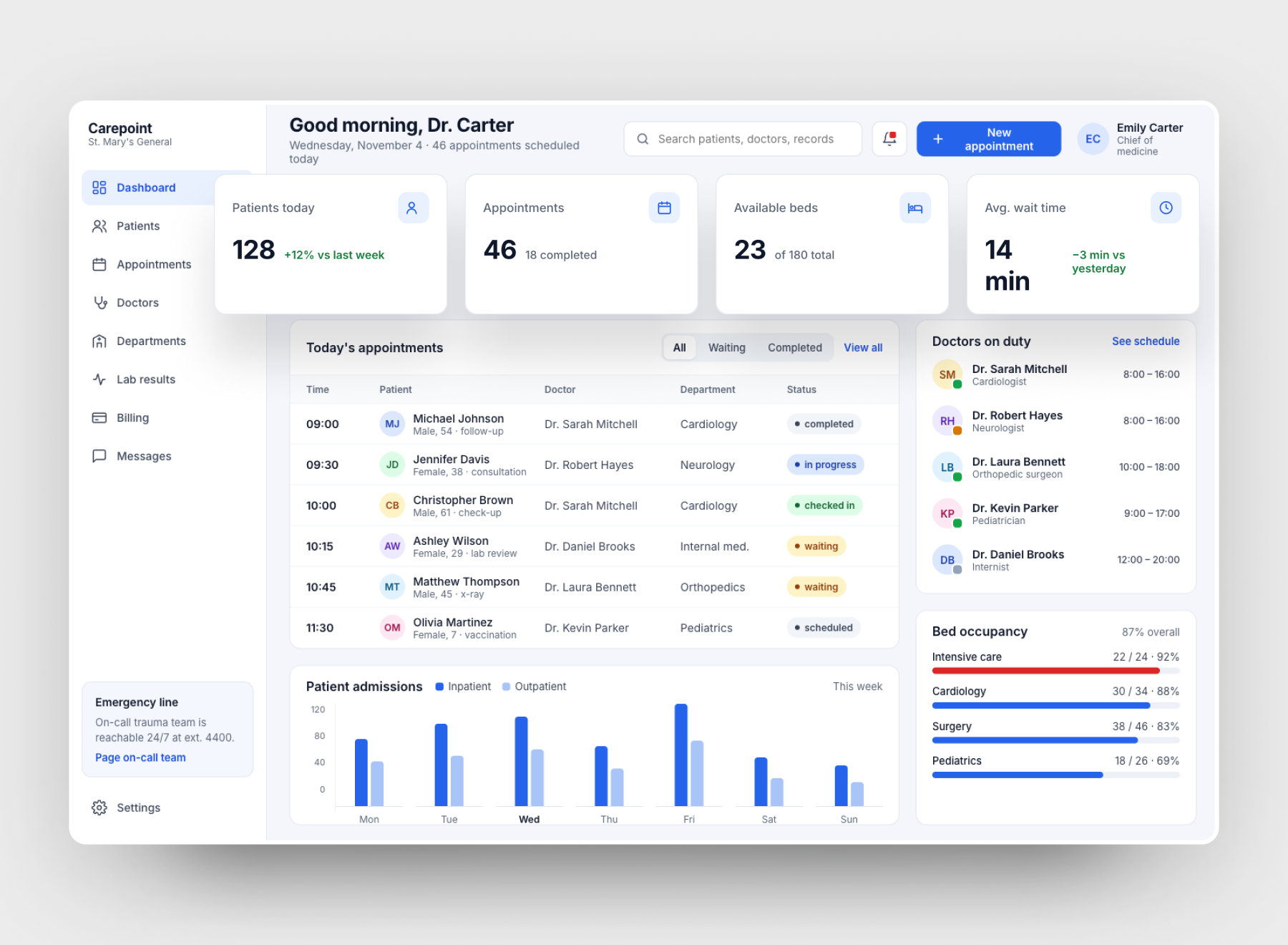
Hospital app development aims at building web and mobile apps that streamline hospital workflows and support care delivery across clinical and administrative functions, from patient admission to discharge and follow-up visits.
Challenges & Solutions
Below are the most common challenges our clients face when developing hospital apps, along with the approaches IT Craft engineers use to overcome them.
-
“We need a HIPAA-compliant hospital app — and proof that patient data is protected.”
It may be hard to keep a hospital app in line with HIPAA & HITECH when PHI flows through dozens of user accounts, devices, and integrations. Our engineers implement PHI safeguards at every level of the app, from encrypted data storage and role-based access to audit trails and documentation for compliance reviews.
-
“Our app has to work with Epic, Cerner and 20 other systems we already run.”
Hospital app interoperability is often limited by the variety of systems already in use, from EHRs to LIS, RIS/PACS, billing, and scheduling software. IT Craft connects the app with these systems via HL7, FHIR, and DICOM, so data reaches clinicians and patients without double entry or manual workarounds.
-
“We need to connect to EMR systems, labs, pharmacies — and nobody can do it.”
Third-party integrations may take more time than the app development itself, especially when vendors offer limited documentation. With lots of healthcare integrations delivered, our engineers know how to work with EHR/EMR APIs, LIS, insurance pre-authorization services, pharmacy systems, and Bluetooth-enabled medical devices.
-
“Patients and staff are counting on this app. We can’t afford a failed launch.”
A hospital app launch is associated with the risk of disrupted care and lost staff trust. We plan the rollout around hospital operations, with clear milestones, workflow validation, performance testing, and support for each department.
Costs & Timelines
Based on IT Craft’s healthcare software projects and industry benchmarks, the cost of custom hospital app development may range from $40,000 to $500,000+, depending on app scale and complexity, the number of integrations, as well as security and compliance requirements.
| Project Scope / App Type | Typical Cost Range | Estimated Timeline |
|---|---|---|
| Basic / MVP Hospital App | $40,000–$80,000 | 4–6 months |
| Mid-Complex Hospital App | $80,000–$250,000 | 6–12 months |
| Enterprise Hospital Platform | $250,000–$500,000+ | 12–18+ months |
Core Cost and Timeline Drivers
Major factors that affect the development budget and timelines are:
- The required regulatory compliance (HIPAA, GDPR, etc.).
- The number and complexity of integrations with EHR/EMR systems (e.g., Epic, Oracle Health), LIS, RIS/PACS, and billing tools.
- The required platform scope (web app, native iOS and Android apps).
- The location of the development team.
- The volume of ongoing maintenance (hosting, security patches, regulatory updates).
- (for outsourced development) A vendor’s service pricing model.
Types of Hospital Apps We Develop
IT Craft delivers end-to-end hospital solutions, covering their implementation, integration, and modernization. Our engineers have experience with the following software types:
Hospital Operations
- EHR and HIE solutions
- Admission, discharge, and transfer (ADT) software
- Hospital information systems (HIS)
- Hospital inventory and asset management software
- Healthcare data analytics solutions
- Revenue cycle management (RCM) software
- Medical practice management software
- Appointment scheduling apps
- CRM software for healthcare
- AR/VR solutions for medical staff training
Treatment and Clinical Care
- Medical diagnostic software
- Prescription assistance and clinical decision support (CDS) solutions
- Computerized physician order entry (CPOE) and nursing information software (NIS)
- Pharmacy information management systems (PIS)
- Laboratory management and information systems (LIS)
- Medical imaging analysis software
- Picture archiving and communication solutions (PACS)
- AR/VR solutions for surgical planning
Patient Care and Engagement
- Patient portal solutions
- Apps for patient engagement
- Chronic disease management software
- Telemedicine applications
- Remote patient monitoring solutions
- AI chatbots for healthcare
- Inpatient care applications
- Outpatient care applications
Hospital App Development Roadmap
The hospital app development process largely depends on the app purpose, its complexity, and target users (medical specialists, patients, administrative staff). Below, IT Craft’s consultants share a sample plan built on our 20+ years of experience in healthcare IT.
-
Concept and Requirements
Business analysts study hospital workflows and target users, define the feature set and compliance strategy, and document everything in a software requirements specification (SRS).
-
Project Planning
Project managers set the project scope, delivery schedule, and budget, handle resource planning, and keep a risk mitigation plan up to date.
-
Architecture and Integrations
Solution architects design a secure architecture and plan EHR/CRM/LIS integrations based on HL7/FHIR, USCDI, and clinical terminologies (LOINC, SNOMED CT, RxNorm).
-
UI/UX Design
UX and UI designers map user journeys for each set of user roles and permissions, focusing on usability and accessibility in line with the Mobile Content Accessibility Guidelines (MCAG).
-
Development and QA
Developers build a minimum viable product (MVP) in 2–4 week iterations with secure coding and hospital system integrations, while QA engineers run functional and security testing in parallel.
-
Pre-Launch Preparation
QA engineers run a compliance pre-audit, prepare FDA/MDR submission for apps with SaMD functionality, and support a pilot roll-out to collect user feedback.
-
Launch and Ongoing Support
After release, our team provides medical staff training, troubleshooting, and performance monitoring, along with cloud consumption optimization and regular feature updates.
Why Develop a Hospital App with IT Craft
- Since 2001 in software development and in healthcare IT.
- 330+ IT experts and a 4.9 rating on Clutch.
- Hands-on experience with HIPAA, Cures Act, GDPR, FDA, MDR, SAMHSA, CEHRT, and SAFER requirements.
- Proficiency in healthcare standards such as HL7/FHIR, ICD-10, CPT, X12 837/835, XDS/XDS-I, DICOM, NCPDP SCRIPT, CDA, and CCD.
Our Engagement Models
Dedicated Team
+ Full project control with a dedicated development team working only on your app.
+ Access to specialized skills and flexible team scaling.
+ Ongoing collaboration with the same engineers over time.
– Requires your involvement in setting priorities and reviewing progress.
Staff Augmentation
+ Additional development talents for skill gap coverage.
+ Flexible team scaling.
– Distributed team management can be a challenge.
Outsourcing
+ A self-managed team takes care of end-to-end development, as well as project management and delivery.
+ Optimized costs and easy resource scaling.
-The outcome depends on the vendor’s maturity.
Technology Stack
Contributor
-
Healthcare IT Expert & Consultant