Custom Medical Device Software Development
IT Craft provides custom medical device software development services backed by 20+ years of software engineering experience. We rely on proven software architecture and project management to build secure, regulatory-ready SaMD and software for medical devices that streamline clinical workflows and improve diagnostic accuracy.
 Overall review rating
Who We Develop Medical Device Software For
We cover the full medical device software development lifecycle, including design, implementation, integration, and technical support for care providers, medical equipment manufacturers, and healthcare startups. We follow medical device industry requirements throughout development to ensure user safety, software reliability, and data protection. We develop solutions for:
- Medical device and equipment manufacturers
- Healthcare startups
- Hospitals and clinics
- Laboratories
- Blood banks
- Research centers
- Pharmacies
- Medical education providers
- Hospices and nursing homes
- Home healthcare and in-home use
- Other healthcare and care facilities
Costs & Timelines
The cost to develop custom medical device software usually ranges from $100,000 to $2,000,000+. A mainstream build with SaMD functionality, embedded device integration, IoMT connectivity, real-time device data processing, and FDA/IEC 62304 compliance requirements typically costs $200,000 to $500,000, while an advanced solution runs $500,000 to $2,000,000+.
Medical Device Software Cost Estimates
| Project type | Estimated cost | Typical timeline |
|---|---|---|
| MVP Medical Device Software | $100,000–$200,000 | 4–6 months |
| Mainstream SaMD / Embedded System | $200,000–$500,000 | 6–12 months |
| Advanced Medical Device Software | $500,000–$2,000,000+ | 9–24+ months |
Key Cost Factors
Major factors that shape the development budget and timeline include:
- Functional scope and complexity of the medical device software.
- Number and complexity of integrations with medical devices and healthcare systems.
- Performance, scalability, cybersecurity, data protection, and regulatory compliance requirements.
- Required development scope — from a PoC or MVP to a fully featured, production-ready solution.
- Selected sourcing model and development team composition.
- The vendor's pricing model and engagement structure for outsourced development.
Why Choose IT Craft for Medical Device Software Development
- 20+ years in software development since 2001, including healthcare IT, specialized workflows, patient-facing applications, and facility-specific solutions.
- Strong knowledge of IEC 62304, HIPAA, HITECH, FDA 21 CFR Part 11, and FDA 21 CFR Part 820 requirements.
- Proven work with FDA Class II and III medical devices and IEC 62304 software safety classes A, B, and C.
- Expertise in healthcare standards and clinical terminologies, including HL7, FHIR, DICOM, XDS/XDS-I, ICD-10, CPT, and SNOMED CT.
- Support for FDA registration and CE marking of medical device software.
- Field-tested quality management and security management practices for reliable, secure healthcare software.
- Microsoft Partner and AWS Advanced Tier Partner, with international software delivery across the US, Europe, and other global markets.
How to Develop a Medical Device Software: Step by Step
-
Define requirements, assess risks, and approve the software specification.
-
Plan architecture, roadmap, technical documentation, and UX/UI.
-
Develop cross-platform application using Agile, Scrum, or Waterfall.
-
Integrate devices, IoMT, EHR/EMR, and HL7/FHIR systems.
-
Perform QA, security testing, code reviews, validation, and verification.
-
Prepare regulatory documentation for FDA 510(k), CE/MDR/IVDR, HIPAA, GDPR, IEC 62304, and IEC 82304-1.
-
Support regulatory submission, deployment, and software release.
-
Monitor performance and security, resolve issues, and deliver upgrades.
How We Solve the Most Common Challenges
| Challenges | Solutions |
|---|---|
| Complex compliance and certification procedures | IT Craft navigates regulatory requirements and prepares the documentation for software clearance and audits, including FDA and MDR requirements, with a transparent, audit-ready process. |
| Slow market entry | We help accelerate delivery with clearly defined milestones, responsive project management, and an MVP-first approach, while keeping agreed timelines without compromising software quality. |
| Medical device integration issues | Our engineers design flexible architectures that simplify medical device and SaMD integration, so adding new device models and types takes minimal rework. |
| Vendor lock-in | We provide well-structured project code, tests, technical documentation, and knowledge transfer, so you can continue with IT Craft or move support and maintenance to another vendor if needed. |
Services We Provide
Consulting
We assess your business, clinical, and technical requirements to choose the right medical device software type, its functionality, compliance needs, and implementation roadmap.
Implementation
Our development team builds custom medical device software around your workflows, product requirements, and regulatory needs, and implements it into your existing healthcare IT environment.
Integration
We integrate medical software with medical equipment, EHR/EMR systems, healthcare platforms, third-party applications, and other connected solutions.
Maintenance & Support
Our support team keeps your medical device software running, monitoring system performance and security, resolving issues, and delivering updates and functional improvements when needed.
Types of Solutions We Implement
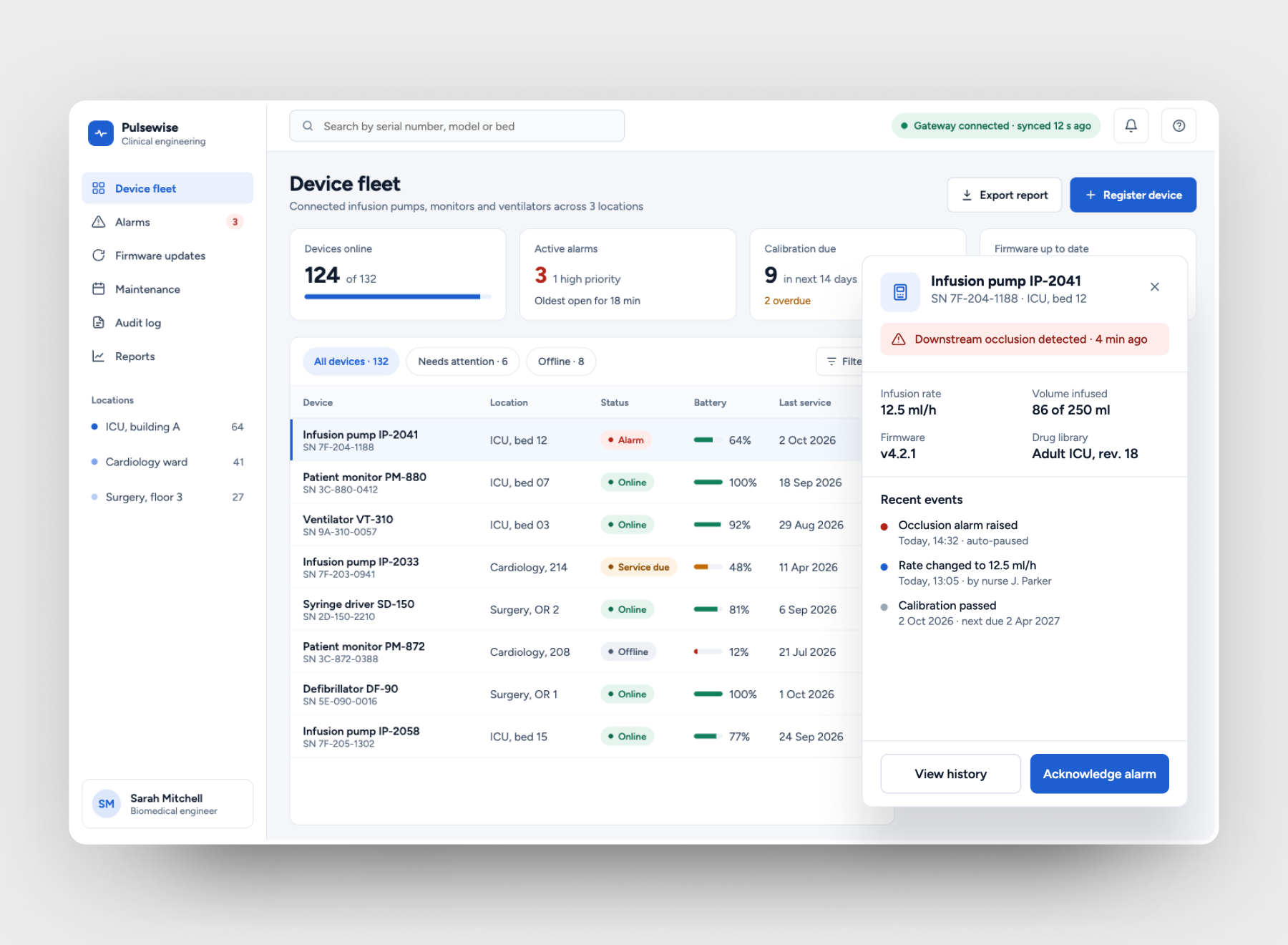
We develop Software as a Medical Device (SaMD) and software for medical devices designed for hospital, home, and on-body use. Built in line with medical regulations, our solutions enable real-time device monitoring and management, health data collection and analysis, and connectivity with peripheral smart devices such as barcode scanners, biometric and RFID readers, temperature, humidity and cardiac sensors, scales, smart pens, and tubing welders.
In-Hospital
- Smart carts
- Blood collection devices
- Medical imaging systems
In-Home
- Smart inhalers
- Voice assistants
- Baby care devices
- Thermometers
On-Body
- Smartwatches
- Fitness trackers
- Blood pressure & heart rate monitors
- Glucometers
- Insulin pumps
Class II Medical Devices
- CT scanners
- Wearable glucose monitors
- Blood pressure monitors
- Wearable ECG sensors
Class III Medical Devices
- Pacemakers
- Cardioverter-defibrillators
- Deep-brain stimulators
Software as a Medical Device (SaMD)
- Smartphone and tablet applications
- PC and laptop software
- Smart TV applications
- Smartwatch & wearable applications
Key Modules & Features for Medical Device Software
Mobile App
Mobile access to medical device software and SaMD data helps healthcare professionals monitor devices, review patient information, and support disease management from anywhere.
Advanced Analytics
With AI and ML, medical device software analyzes connected-device data to identify patient trends, predict disease progression, detect early warning signs, and evaluate treatment or medication effectiveness.
Cloud Platform
A cloud platform collects data from connected medical devices such as glucose monitors, pacemakers, and smart inhalers for analytics, diagnostics, and treatment support. It also enables remote device management, failure detection, and parameter configuration.
IoT-Based Medical Device Tracking
IoT-enabled tracking helps identify device locations, manage disinfection and sanitation, reduce equipment search time, and support remote maintenance of medical devices.
Real-Time Health Monitoring
Medical device software collects, stores, and analyzes real-time patient health data, including blood glucose levels, heart rate, and sleep data, to automate clinical workflows and support continuous patient monitoring.
Medical Device Software Use Cases
Remote Care & Telemedicine
Medical device software enables remote patient monitoring and virtual care by collecting health metrics from connected sensors and syncing patient data with clinical systems for healthcare professionals to review.
Patient Self-Service
SaMD solutions help patients track lifestyle, sleep, nutrition, and mental health, manage connected medical devices through mobile apps, and update personal health information remotely.
Diagnostic & Treatment Assistance
Software speeds up diagnostics and treatment workflows, including blood testing, MRI and CT scans, X-rays, and other clinical procedures, and makes them easier for clinicians and patients.
Mass Measurement & Analysis
Custom solutions precisely measure small and large quantities of substances and run compound analysis for laboratory processes and medication quality control.
Facilities Monitoring & Management
Facility systems handle inventory management, resource tracking, environmental monitoring, and equipment control, covering air and water quality, temperature, infection alerts, and other safety-critical facility conditions.
Medication Management
Medical device solutions keep medication administration safe and timely through reminders, medication pumps, adverse reaction and drug interaction tracking, and medication storage, dispensing, and disposal monitoring.
Medical Device Software Integrations
A connected ecosystem of medical devices and healthcare software helps organizations streamline operations, meet regulatory requirements, reinforce cybersecurity, and deliver better patient care. IT Craft connects devices, clinical systems, and healthcare platforms to support secure and reliable data exchange across the entire environment.
EMR/EHR
Integration with EMR/EHR systems updates patient information automatically, drawing on data from connected devices and analytical insights into patient condition changes.
Hospital Management Software
This integration lets you move toward an automated smart hospital, streamline routine tasks, and control all your connected medical devices from one system.
Pharmacy Management Software
Through pharmacy management modules, hospitals can dispatch medications automatically and prevent adverse reactions by analyzing data from patients' medical devices.
Telehealth
Medical device software integration with telehealth and telecare platforms enables full-scale online consultations, remote examinations, diagnostics, and treatment validation.
Compliance & Security
We develop medical device software with security, regulatory compliance, and healthcare interoperability requirements built into the development process.
- Regulatory standards: IEC 62304, IEC 82304-1, FDA requirements, 21 CFR Part 11, 21 CFR Part 820
- Data privacy & security: HIPAA, GDPR, secure data storage, encryption, access controls
- Medical device classification: FDA Class II & Class III, IEC 62304 Classes A, B & C
- Healthcare interoperability: FHIR, HL7, SMART on FHIR, DICOM, XDS/XDS-I
- Clinical data standards: ICD-10, CPT, SNOMED CT
Technology Stack
Advanced Technologies for Medical Device Software Development
We combine medical device software development expertise with advanced technologies to extend device capabilities, improve diagnostics and clinical decision-making, automate workflows, and deliver more personalized patient care.
- IoT for Medical Devices
- Artificial Intelligence for Medical Devices and SaMD
- Machine Learning
- AI for Medical Diagnosis
- AI for Treatment Personalization
- Medical AI Chatbots
- Medical Image Analysis
- Computer Vision
- Speech Recognition for Healthcare
- AR/VR
- Big Data
- Data Science
- Blockchain
Benefits of Custom Medical Device App Development
Better Patient Outcomes
SaMD and medical device applications help patients better understand and manage their health, reduce human errors, and improve diagnostic accuracy.
Reduced Cost of Care
Automation through connected medical devices and applications reduces manual workload, saves clinical staff time, and can help lower hospitalization and infrastructure costs.
Enhanced Patient Engagement & Loyalty
Medical device apps give patients more control over their health and provide more convenient digital services, supporting higher satisfaction, engagement, and long-term loyalty.
New Business Opportunities
Smart medical device software helps healthcare organizations optimize resources, reach new patient groups, and introduce fresh digital services and care models.
Data Safety
Secure medical device software supports compliant collection, storage, transfer, and removal of sensitive health data while reducing the risk of human error, ransomware attacks, data breaches, and accidental leaks.
Contributor
-
Healthcare IT Expert & Consultant