Mental Health App Development
Development Steps , Costs and Timelines
Mental health app development aims to create accessible, reliable applications that help patients reach professional support and monitor their condition in a guided way. IT Craft’s mental health app developers, backed by a 20+ year software development company, build apps for therapy, behavioral healthcare, and mindfulness that bring digital mental wellness into everyday care.
 Overall review rating
Mental Health App Development Costs and Timelines
Сosts of app development range from $40,000–$80,000 for an MVP build (3–6 months) with core tracking, basic content modules, and essential security, up to $150,000–$400,000+ for an advanced solution (6–12 months) with AI chatbots, complex EHR integrations, and multi-tenant B2B structures.
| Scope | Cost range | Timeline |
|---|---|---|
| MVP build | $40,000 – $80,000 | 3–6 months |
| Full-featured app | $80,000 – $150,000 | 5–9 months |
| Advanced platform | $150,000 – $400,000+ | 6–12 months |
How to Develop a Mental Health App in 6 Steps
-
Define target audience, MVP, and regulatory requirements.
-
Design accessible, WCAG-compliant UX and prototypes.
-
Build a secure backend and integrate third-party SDKs.
-
Add AI models and wearable device syncing.
-
Run security testing and a compliance audit.
-
Launch, then iterate on analytics and clinical feedback.
Core Features for Mental Health Applications
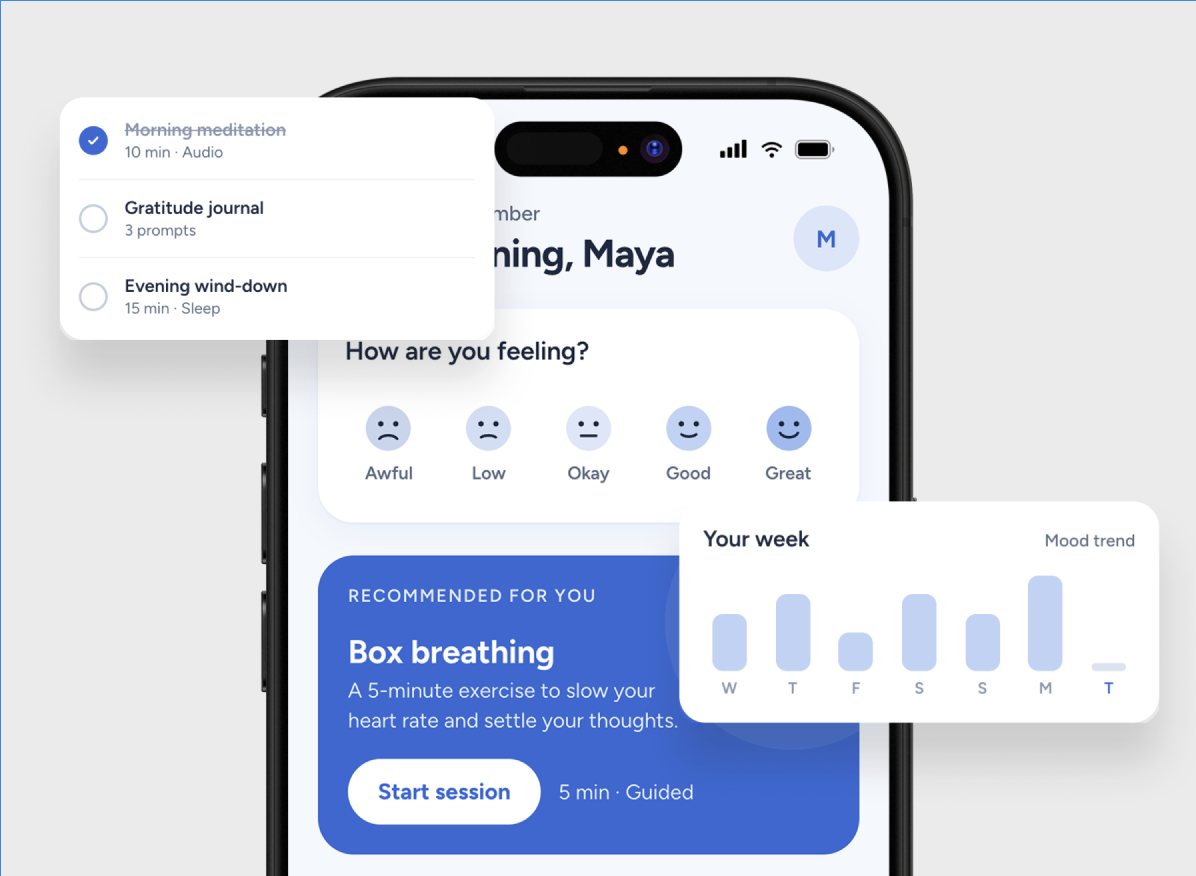
Mood & Symptom Tracking
- Daily check-ins to log mood and emotional state.
- Journaling prompts for recording feelings and thoughts.
- Symptom and trigger trackers with regular reminders.
- Visual analytics and charts to spot emotional patterns over time.
Crisis Support Access
- Permanently accessible emergency hotlines within the app.
- Personalized safety plans built with a therapist.
- An emergency support button reachable from any screen in one tap.
- Crisis resources located instantly within the UI.
Guided Content Library
- Evidence-based exercises rooted in Cognitive Behavioral Therapy (CBT).
- Guided mindfulness and meditation sessions.
- Stress reduction techniques (e.g., breathing exercises).
- Educational articles and self-help materials by condition.
Telehealth Integration
- Secure video calls with licensed therapists.
- Instant text messaging between sessions.
- Therapist-matching based on symptoms and preferences.
- In-app scheduling and session reminders.
Crucial Compliance & Security
Data Privacy Regulations
Mandatory adherence to HIPAA (US) or GDPR (EU), depending on your target user base.
Security Standards
End-to-end encryption (AES-256) for data at rest and in transit, multi-factor authentication and role-based access control, secure audit logs for full traceability.
Interoperability
Integration standards like HL7/FHIR for connecting with existing Electronic Health Record (EHR) systems.
Mental Health Challenges and Solutions
High Cost of Therapy
Online therapy sessions eliminate the need for an office and front-desk staff, resulting in reduced operational costs. Thus, prices for virtual consultations are much more affordable.
Difficulty Maintaining Mindfulness Habits
Apps provide regular reminders and encouragement to help people stick to their mindfulness routines. Habit streaks and progress tracking turn practice into a daily routine.
Low Engagement Among Older Adults
Mental health app developers can specifically target their apps to an older audience with accessibility features: larger fonts, simplified navigation, and voice input.
Limited Access to Therapists
Using an app, people can find a therapist anywhere in the world through therapist matching and remote therapy, including multilingual support.
In-Person Therapy Can Feel Intimidating
Those seeking to try meditation sessions or online group therapy for the first time can do so through anonymous participation and a low-pressure entry point.
Limited Support Between Therapy Sessions
Between sessions, apps offer continuous support through mood tracking and self-help tools, with personalized reminders and exercises to keep progress going.
Mental Health App Development Services We Offer
Telepsychiatry
Telepsychiatry apps deliver remote psychiatric care by connecting patients with licensed clinicians through video consultations and secure messaging. IT Craft builds platforms that handle psychiatric assessments and e-prescriptions end to end, so care never depends on a physical visit.
Mood & Symptom Tracking Apps
Mood and symptom tracking apps let users monitor their emotional state day to day through mood tracking and symptom logs, turning everyday entries into behavioral insight for patients and clinicians.
Mental Health Practice Management System
A practice management system runs the clinical and administrative side of a practice — from appointment scheduling and billing to documentation and reporting — in one secure place.
Mindfulness Apps
Mindfulness apps help users build calm into their routine through guided meditation and breathing exercises. Our engineers add daily streaks, reminders, and progress tracking that keep the habit alive.
Addiction Recovery Apps
Addiction recovery apps support people working to stay sober through recovery tracking and structured goal setting, with community features and relapse-prevention tools.
Mental Health App Integration Services
Telehealth & Teletherapy Integration
- Video consultations for remote therapy sessions
- Secure messaging for therapist–patient communication
- Appointment scheduling built into the care flow
- Patient privacy protected by HIPAA-compliant development
Wearable Device Integration
- Activity tracking synced from wearable devices
- Sleep monitoring across daily and nightly cycles
- Heart rate data streamed in real time
- Personalized insights drawn from wearable data
EHR Integration
- Integration with Electronic Health Records (EHR) systems
- Seamless access to patient records and treatment history
- Secure data exchange between app and healthcare providers
- HIPAA-compliant storage for patient confidentiality
Key Benefits of Mental Health Apps
Better Patient Care & Engagement
Mental health apps offer 24/7 support, reaching patients beyond clinical settings. They tailor personalized care plans to individual needs, while progress tracking, reminders, and gamification keep patients engaged between visits.
Lower Operational Costs
Healthcare providers reach patients through remote care delivery, cutting operational costs. Admin work like appointment scheduling, billing automation, and payment processing happens in the app with just a few clicks.
Expanded Access to Mental Health Care
An app lets healthcare institutions offer remote consultations across a wider geographic reach, opening much bigger markets. Scalable digital services bring care to underserved users who were previously out of range.
Improved Data & Insights
Patient data collection turns everyday app use into actionable insight. With progress monitoring, behavioral trends, and analytics, providers spot what works and refine care over time.
Technology Stack
FAQ
With 20+ years of software development experience, IT Craft combines healthcare and mental health expertise with custom end-to-end development, AI-powered personalization, and secure, privacy-focused engineering. We build scalable mental health solutions tailored to patient, provider, and business needs.
Our mental health app developers have shipped digital wellness solutions across therapy, tracking, and recovery. We implement:
- Teletherapy and secure video sessions
- Mood and symptom tracking with behavioral insights
- CBT exercises and guided self-help
- Secure communication and personalized user experiences
Every feature is built to HIPAA standards from the first sprint, not retrofitted later.
Before signing, check three things:
- Portfolio — proof they’ve built the type of mental health app you need
- Technology fit — coverage of your required features, integrations, and scalability
- Compliance — a working grasp of healthcare security, privacy, and regulatory requirements
If a vendor can’t show all three, keep looking — the wrong fit costs more to fix than to avoid.
Yes. IT Craft supports mental health apps well past launch, including:
- Bug fixes and security updates
- Performance optimization
- Ongoing feature improvements
Support continues as long as your app is live — security and compliance patches don’t wait for the next release cycle.
Contributor
-
Healthcare IT Expert & Consultant
Need to design, develop, or improve your software?
Tell us about your project — we'll get back within one business day.