Patient Portal Software Development
Since 2001 in healthcare, IT Craft plans and builds patient portals that make day-to-day interaction with patients faster and more secure for clinics, hospitals, and private practices.
 Overall review rating
Patient Portals Explained
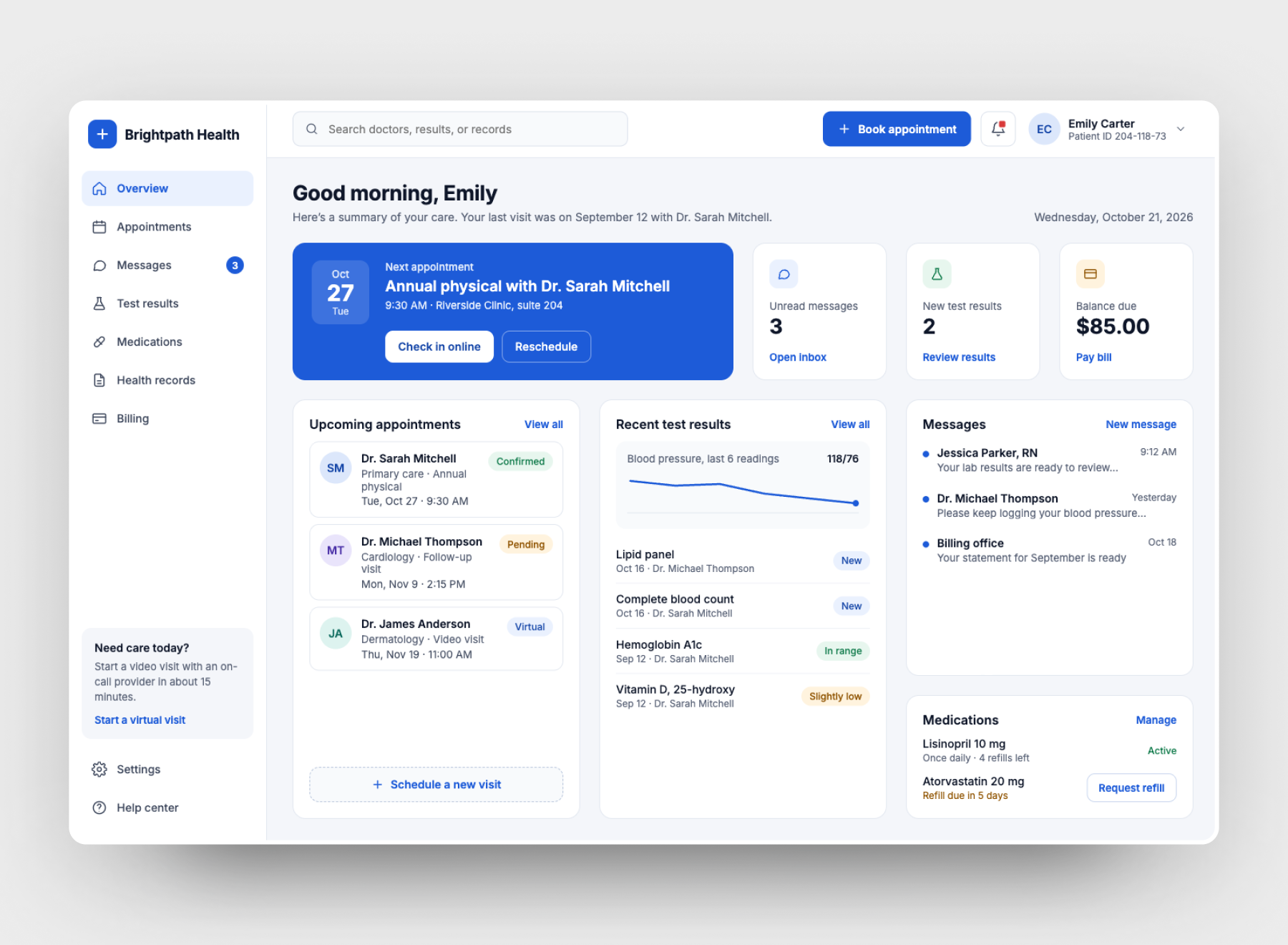
A patient portal gives patients secure 24/7 access to their personal health information (PHI), medical advice, and self-service options without calling the front desk. A patient-facing self-service portal streamlines communication with a healthcare provider and drives patient engagement throughout the treatment process. IT Craft builds patient portal software that helps patients access their records and stay in touch with their doctors.
- Key functionality: doctor visit arrangement, disease-specific modules, telehealth, payments, and integration with the IT environment.
- Costs: from $40,000 to $500,000+
Costs & Timelines
Based on IT Craft’s healthcare software projects and industry benchmarks, the cost of custom patient portal development may range from $40,000 to $500,000+, depending on portal scale and complexity, the number of integrations, as well as security and compliance requirements.
| Project Scope / Portal Type | Typical Cost Range | Estimated Timeline |
|---|---|---|
| Basic / MVP Portal | $40,000–$75,000 | 2–4 months |
| Mid-Complex Portal | $80,000–$200,000 | 4–8 months |
| Enterprise Patient Platform | $200,000–$500,000+ | 9–14+ months |
Core Cost and Timeline Drivers
Major factors that affect the development budget and timelines are:
- The required regulatory compliance (HIPAA, GDPR, etc.).
- The number and complexity of integrations with EHR/EMR systems (e.g., Epic, Oracle Health), payment gateways, and telehealth tools.
- The number of user roles and access levels.
- The volume of legacy patient data migration.
- The required platform scope (mobile-responsive web portal, native iOS and Android apps).
- (for outsourced development) A vendor’s service pricing model.
Client Pain Points & Solutions
Below are the most common challenges our clients face when developing patient portals, along with the approaches IT Craft engineers use to overcome them.
Challenge
Solution
- Patients may abandon a portal when its navigation is too complex, especially elderly and low-vision users.
- Our designers build accessibility-first interfaces in line with WCAG 2.2, with single-click paths to appointment scheduling, lab results, and messaging a doctor.
- It may be hard to keep a patient portal in line with HIPAA and the 21st Century Cures Act when PHI is accessed by thousands of patients from different devices.
- Our engineers implement PHI safeguards at every level of the portal, from end-to-end encryption and MFA to role-based access and audit logs.
- Portal sync with Epic or Oracle Health (Cerner) is often limited by fragmented and duplicated patient data.
- Our team consolidates patient records and connects the portal with EHR/EMR systems via HL7 FHIR APIs and secure middleware. Medical history updates, pre-visit questionnaires, and prescription refill requests are then synced without double data entry.
- Data security cannot be ensured once and for all, as each new module, such as telehealth or billing, adds entry points for attackers.
- In addition to a Zero-Trust architecture, AES-256 and TLS 1.3 encryption, and strict RBAC, IT Craft isolates video consultations, payment details, and medical records from each other and performs penetration testing before releases.
- Phone calls, paper forms, and payment reminders take up a large share of the front desk’s time.
- Our team moves routine front-desk tasks into the portal, from digital intake and e-consent to automated appointment reminders, secure messaging routed to the right staff member, and online bill pay with payment plans.
Core Features of a Successful Patient Portals
IT Craft’s medical IT experts design the patient portal feature set to match the business needs of each healthcare organization. Below, based on our 20+ years of healthcare expertise, we describe the functionality often requested by our clients.
Patient access to personal health information
- Encrypted, password-protected login to a personal profile.
- Health history, diagnoses, allergies, and chronic conditions view.
- Lab test results and discharge summaries (view and download).
- Treatment, procedure, and medication plans.
- Personalized after-treatment recommendations and educational materials.
Doctor visit arrangement
- Online appointment scheduling.
- Upcoming appointments view and rescheduling.
- Detailed visit history.
- Pre-visit forms filled in online.
- Automated reminders (SMS or portal notifications).
Secure patient-doctor communication
- Secure messaging with a doctor.
- Video consultations.
- Protected access to mental and behavioral health records.
- After-visit surveys.
- A dedicated clinical trial portal for research participants.
Payment and insurance management for patients
- Bills and explanations of benefits (incl. CPT billing codes, when supplied by the EHR or payer).
- Online bill payment.
- Insurance coverage cases list.
Online patient requests
- Prescription refill requests.
- Medical procedure requests.
- Contact information, billing information, and health record update requests.
Portal administration
- User access management for new patients.
- Patient health and contact information editing.
- Clinical document uploads from other providers (e.g., C-CDA visit summaries).
Client Spotlight
Patient Support Portal for People with Complex Medical Needs
IT Craft designed and developed a secure web-based patient portal for a healthcare provider serving patients with complex medical needs. The portal gives patients condition-specific resources and validated treatment information, lets them contact clinicians directly, and is integrated with medical staff databases and a local SMS gateway.
Integrations
Our solution architects connect a patient portal to the EHR/EMR and CRM. This gives staff and patients a holistic patient health history, removes repetitive data entry, lowers patient data management costs, and prevents fragmented or duplicated information.
EHR / EMR (Electronic Health Records or Electronic Medical Records)
To share patients’ health history, treatment plans, and billing history in their personal portal accounts and pull patient-driven information (pre-visit information, payment updates, etc.) from the portal.
CRM (Customer Relationship Management)
Or call center software and Practice Management System, to collect each patient’s visit history, health support requests, and messaging history and offer personalized care options.
Patient Portal Software Development Process
We deliver a portal in iterations, and each development step ends with an artifact your team can review.
-
Analysis and Requirements
Analyzing the needs of your healthcare organization and patients to define the key portal functions, choose between web and mobile development, and create a requirements specification.
-
Technical Design
Creating the portal’s tech design, including the tech stack, integrations, FHIR APIs, USCIS-aligned data scope, etc.
-
Compliance Planning
Designing a compliance roadmap for HIPAA, GDPR, the 21st Century Cures Act, and other applicable regulations.
-
UX and UI Design
Planning the UX of a patient portal and designing UI elements that follow the healthcare organization’s brand book and focus on ease of use and accessibility.
-
Development and Testing
Patient portal development and testing in iterations.
-
User Training Preparation
Preparing training materials for staff roles within the healthcare organization and quick start guides for patients.
-
Portal Launch
Launching the patient portal.
-
Support and Maintenance
Supporting and maintaining the portal for a stable patient experience.
Key Factors for Patient Portal Success
To get the full value from a patient portal, pay attention to three things:
Easy-to-Use Navigation
Intuitive navigation lets both expert and novice users find what they need on the first try.
Mobile-Friendly Optimization
Patients open the portal on smartphones, tablets, and PCs, at home and on the go, and it has to work on every one of them.
Patient Portal Promotion
Promote the portal as the central communication tool for patients. The higher the adoption, the lower the call center load.
When a Custom Patient Portal Is Your Best Option
IT Craft recommends that healthcare providers choose a custom patient portal when they need to:
- Integrate with Multiple Systems: EHR/EMR, CRM, RIS (radiology information system), marketing automation software, and especially legacy systems.
- Provide branded UI: a branded UI that is hard or impossible to build within out-of-the-box configuration.
- Apply Advanced Patient Engagement Techniques: gamification elements, such as achievements and social media sharing.
- Incorporate Telehealth Functionality: remote patient care, including e-visits.
If none of these apply, a portal module built into your EHR may be enough, and we will tell you so at the consulting stage.
Our Custom Patient Portal Development Services
With 20+ years in healthcare web portal development, IT Craft keeps projects on track despite time and budget constraints and changing requirements.
Consulting
Our healthcare IT consultants:
- Analyze patient interaction workflows.
- Define the features and tech stack, including data and terminology mappings (LOINC for labs, RxNorm for medications, SNOMED CT for conditions, ICD-10 for diagnoses).
- Develop a business case.
- Design a secure portal architecture and define the integrations.
- Deliver UX/UI mock-ups.
- Provide pricing and timing estimates.
- Help you comply with HIPAA, HITECH, FDA, the 21st Century Cures Act, NCPDP D.0, etc.
Custom Development
- Consulting, design, and project planning.
- Portal development and quality assurance.
- Regulatory compliance.
- Integration with your EHR, CRM, call center software, and Practice Management System.
- User training.
- Continuous support and maintenance.
Why Develop a Patient Portal with IT Craft
- Deep healthcare and patient portal expertise: 20+ years in healthcare software and since 2001 in IT, with projects like a patient support portal for a healthcare provider.
- Patient portal expertise beyond record access: hands-on experience with patient portals that combine health records, appointment scheduling, telehealth, payments, and clinical workflows.
- Healthcare regulatory and quality expertise: HIPAA, HITECH, GDPR, and 21st Century Cures Act requirements, including patient access to health records.
- Strong interoperability capabilities: EHR, EMR, CRM, and Practice Management System integrations via HL7 and FHIR, with support for ICD-10, CPT, SNOMED CT, LOINC, and RxNorm.
- End-to-end patient portal development: from business and technology consulting to MVP development, integrations, compliance, and ongoing support.
- Security and scalability: patient portal engineering backed by cybersecurity, cloud technologies, UX/UI design, and QA expertise.
- Proven healthcare delivery capabilities: 330+ experts on board, 2,250+ projects delivered, and a 4.9 Clutch rating.
Contributor
-
Healthcare IT Expert & Consultant