Pharmacy App Development
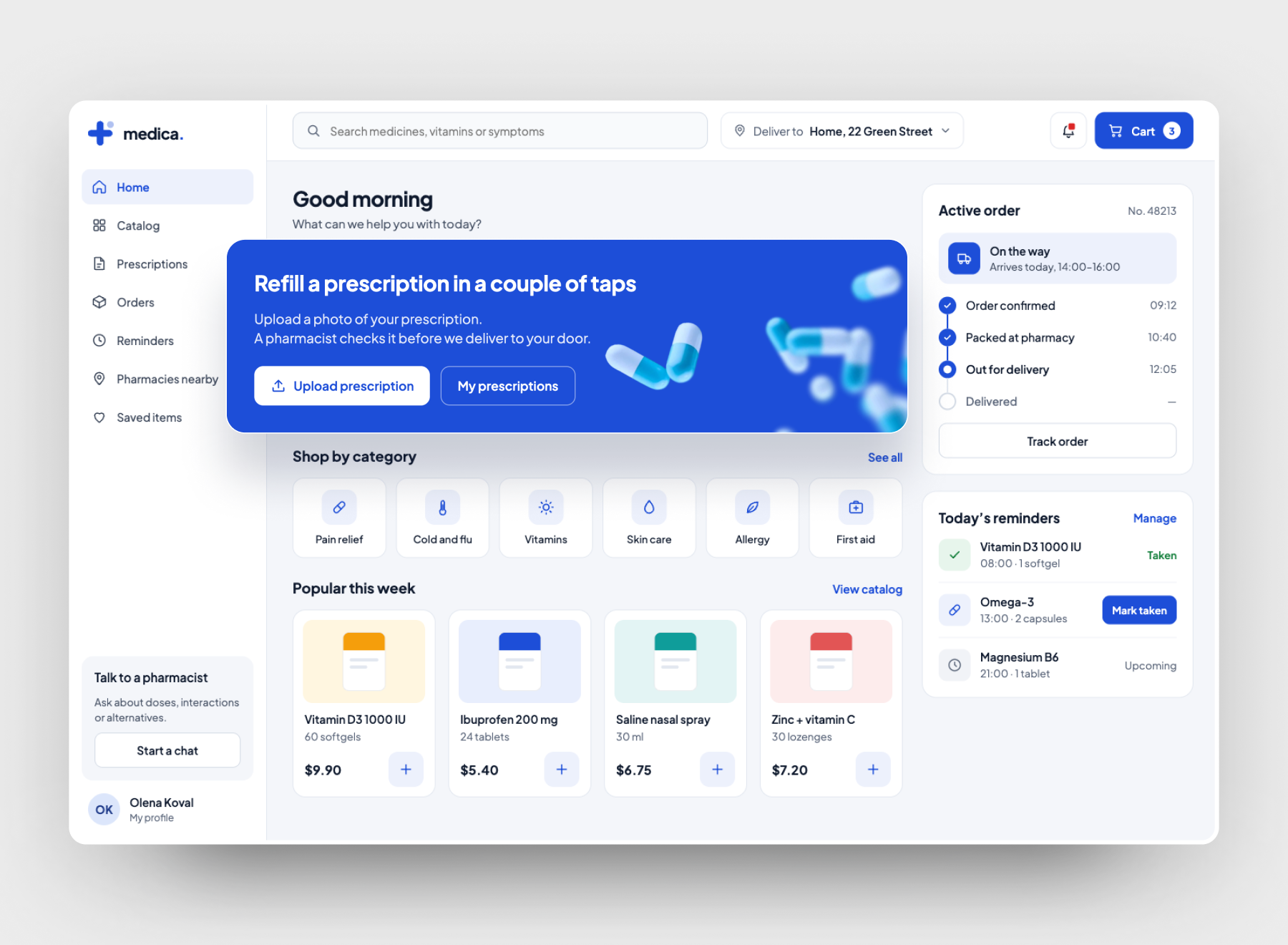
A pharmacy app is a mobile or web application patients use to order medicines, manage prescriptions, and arrange delivery from a pharmacy. IT Craft provides full-cycle development for providers, pharmacy chains, and startups, from HIPAA-compliant architecture to launch.
 Overall review rating
Pharmacy App Development Cost & Timeline
The cost of custom pharmacy app development typically ranges from $25,000 to $250,000+, with a development timeline of 3 to 12+ months.
Cost & Timeline Breakdown by Complexity
Most of the price gap comes from the app's complexity. Here are sample price ranges and timelines for three complexity tiers:
| App Complexity & Tier | Cost Range | Development Timeline |
|---|---|---|
| Basic MVP | 25,000–80,000 | 3–4 months |
| Mid-Range Platform | 80,000–150,000 | 5–11 months |
| Enterprise / Advanced | 150,000–250,000+ | 11+ months |
Core Drivers Behind the Budget
The cost of a pharmacy app varies a lot and depends on multiple factors. Below, IT Craft's healthcare IT experts list the top 7 cost drivers, with the first three moving the price the most:
- Regulatory compliance requirements (e.g., HIPAA, GDPR), incl. data encryption and audit trails.
- The development path: a custom app built around unique workflows or a white-label codebase (the latter can cut launch time to 4–8 weeks).
- Third-party integrations (e.g., EHR systems, insurance platforms, courier services).
- App complexity (its functionality scope).
- App type and platforms (e.g., iOS, Android, web).
- The expected number of users.
- The sourcing model (in-house, outsourcing) and team composition.
*The final budget and timeline depend on the app’s complexity, compliance requirements, and integration scope.
Key Features of a Pharmacy App
Here is a list of the key features for pharmacy apps that are most frequently requested by our clients:
Patient experience
- Account setup and safe access (multi-factor authentication, biometrics).
- Smart medicine finder with filters by availability, price, dosage, and manufacturer (incl. typo-tolerant search).
- Drug information and comparison (side effects, composition, drug compatibility).
- Contacts and chatbot for pharmacist and courier questions.
- Telemedicine (video consultations with a pharmacist or medical consultant).
Prescriptions and orders
- Digital prescription hub (prescription storage, renewals, sharing with pharmacies).
- Doctor verification of prescriptions.
- Real-time order tracking (incl. delivery or pickup selection).
- Order history and treatment history.
- Notifications (order status updates, medication reminders, discount alerts, etc.).
Payments and insurance
- PCI-compliant payment gateway (cards, online wallets, mobile payments).
- Insurance and coverage support (real-time coverage checks, co-pay and deductible calculation).
- Barcode scanning for drug info, reorders, and in-store payments.
Pharmacy operations and AI
- Pharmacist dashboard (for inventory management, order prioritization, low-stock and expiry alerts).
- Analytics on order trends and customer behavior.
- AI drug interaction check (conflicts with current medications, generic alternatives).
- EHR integration via HL7/FHIR (active prescriptions, allergies).
How We Develop Pharmacy Apps
Custom pharmacy app development helps balance regulatory compliance and user experience by tailoring features, UX, and UI to the needs of patients, pharmacists, and administrators. IT Craft guides you through the entire development journey, from discovery to post-launch support.
Key steps to develop a pharmacy app:
-
Discovery and requirements
Our team will:
- Research the market and competitors to find UX references from similar pharmacy apps.
- Define business objectives, user roles (patients, pharmacists, administrators), and success metrics.
- Identify regulatory constraints (e.g., HIPAA, GDPR) and integration needs.
- Create a product requirements document.
-
Feature set and architecture
Our team will:
- Prioritize features and split them into an MVP and post-launch enhancements.
- Recommend the architecture: native iOS (Swift) and Android (Kotlin) apps, cross-platform Flutter or React Native apps, or a web system on React.js and Node.js.
- Advise on AI-powered components (e.g., chatbots, predictive analytics for medication adherence, RAG knowledge bases).
-
UI/UX design and prototyping
Our team will:
- Map out the app concept in a mindmap and create wireframes of key screens.
- Create a design concept and a UI kit with fonts, icons, and buttons.
- Build an interactive prototype and test it with users.
-
Development and testing
Our team will:
- Build a secure backend architecture with role-based access control (RBAC) and encryption at rest and in transit.
- Integrate the app with EHR/EMR systems, e-prescriptions, payment gateways, and telemedicine APIs.
- Hold sprint reviews and demos and share regular progress reports.
- Conduct manual and automated testing, including performance and compliance testing.
-
Deployment and launch
Our team will:
- Set up the infrastructure and configure the cloud environment.
- Submit the app to the App Store and Google Play.
- Configure monitoring tools, analytics dashboards, and logging.
-
Support and maintenance
Our team will:
- Improve the app based on user feedback.
- Deliver compliance updates and protect user data.
- Scale the infrastructure as the user base grows.
-
Pharmacy app evolution
Our team will:
- Plan and add new features, integrations, and modules, including AI.
Types of Pharmacy Apps We Develop
There are various kinds of pharmacy apps that differ in business model, target users, delivery model, and more. Below, IT Craft's consultants share some examples of custom apps commonly requested by our clients from the pharmacy and pharmaceutical domain:
By business model
- Apps for marketplaces (multi-pharmacy listings, real-time stock availability, price comparison).
- Apps for online store (direct-to-consumer ordering, prescription upload, refill reminders).
- Apps for store chains (multi-branch inventory synchronization, centralized loyalty programs).
By target users
- Apps for patients (ordering, refills, order history, insurance handling).
- Apps for pharmacists (inventory, order processing, prescription verification).
- Apps for handbooks (FDA-approved medication lists, immunization calendars for doctors and pharma employees).
By delivery model
- Pharmacy delivery apps (courier delivery with live ETA tracking).
- Click-and-collect apps for pickup from multiple stores.
- On-demand pharmacy apps with doctor appointments.
By platform
- Mobile pharmacy apps (iOS, Android).
- Web pharmacy apps.
- In-store apps integrated with POS and CRM systems.
Integrations
We integrate pharmacy apps with healthcare, business, payment, and delivery systems to expand their capabilities and create a connected pharmacy IT ecosystem with seamless data exchange.
EHR/EMR
We integrate pharmacy apps with EHR/EMR systems through HL7/FHIR to give pharmacists secure access to patients' medication histories.
E-prescribing
We connect e-prescribing systems with your pharmacy app so that electronic prescriptions and refill requests arrive in one place.
Pharmacy management
We facilitate smooth dispensing and billing through pharmacy management system integration with our custom pharmacy software solutions.
Drug databases
By tapping into drug databases, we allow the app to check dosages and drug interactions before an order is confirmed.
Inventory & ERP
We sync inventory and ERP systems with your pharmacy app to keep stock levels and expiration dates up to date across locations.
Payment gateways
We embed secure payment gateways to let patients pay online and get refunds without leaving the app.
Insurance
Our team facilitates real-time eligibility verification and claims processing through integration with insurance systems.
Telemedicine
We connect telemedicine platforms with pharmacy apps to allow digital prescriptions from virtual consultations to reach the pharmacy directly.
Courier & delivery
By connecting courier and delivery services, we enable pharmacies to dispatch orders and share GPS tracking with patients.
CRM
We integrate CRM systems with your pharmacy app to keep customer profiles and loyalty programs in one place.
Technology Stack
Compliance & Security
Pharmacy app development is one of the most heavily regulated areas of healthcare software. IT Craft builds pharmacy apps in line with mandatory and voluntary regulations and standards, since compliance shapes the app architecture, data storage, and even the interface design.
HIPAA (mandatory)
For pharmacy apps that store, process, or transmit Protected Health Information (PHI) in the US. We protect patient data with:
- Encryption.
- Role-based access.
- Audit logs that keep every action traceable.
HITECH Act (mandatory)
For HIPAA-covered pharmacies and their business associates, who must report data breaches. Before your app goes live, we add:
- Real-time monitoring.
- An incident response plan.
GDPR (mandatory)
For pharmacy apps with users in the EU, who must give explicit consent before any data processing:
- Consent management.
- Options for users to view or delete their personal data.
CCPA (mandatory)
For apps serving California residents, who have the right to know, delete, or opt out of data sales:
- User-accessible data management tools.
- Transparent data policies.
PIPEDA (mandatory)
For apps that collect and use personal information of users in Canada:
- Consent tools.
- Limited data collection.
- Safeguards to transfer and store user data.
HL7/FHIR (voluntary)
For pharmacy apps that exchange medical information with EHRs, pharmacy systems, and hospital databases. With its API-based architecture and JSON/XML formats, FHIR fits mobile and cloud-based pharmacy apps.
FDA 21 CFR Part 820 and Part 11 (mandatory)
For pharmacy and MedTech apps that qualify as Software as a Medical Device (SaMD) and must meet FDA quality and documentation requirements.
DSCSA (mandatory)
For pharmacies and other supply chain partners handling prescription drugs, incl. apps for online medicine ordering. The Drug Supply Chain Security Act requires:
- Drug traceability.
- Secure distribution.
- Inventory tracking.
- Authentication of the pharmaceutical supply chain.
NIST Cybersecurity Framework (voluntary)
For pharmacy apps that need a structured approach to cybersecurity, including:
- Risk assessment.
- Access management.
- Secure software development lifecycle (SSDLC).
- Incident response planning.
CSA guidelines (voluntary)
For cloud-based pharmacy services and the data stored in the cloud.
Why Choose IT Craft for Pharmacy App Development
Proven expertise in pharmacy software
A pharmacy app development company with 20+ years in healthcare software, IT Craft builds secure pharma apps and EHR/EMR solutions in line with HIPAA, GDPR, FDA, and other industry regulations.
Full-cycle development
Our 330+ experts cover the entire development cycle, from consulting and UI/UX design to launch and support. Since 2001, we have delivered 2,250+ projects and launched 300+ startups.
Seamless integration with healthcare platforms
To make your app part of the wider healthcare ecosystem, we integrate it with third-party healthcare services and platforms, such as TruePill, HealthTap, MedlinePlus, and OpenFDA.
Flexible cooperation models
Depending on your in-house resources, you can hire a dedicated development team or extend your own team through staff augmentation.
FAQ
Not much at the start! Just share who will use the app and which workflows you want to automate, and our business analysts will help define the rest, required features, integrations, security and compliance needs, and data migration scope, just like we’ve done for 2,250+ projects since 2001.
The risks vary, from incomplete requirements and unclear user roles to integration dependencies and poor data quality in legacy systems, depending on how complex your workflows are. You are welcome to start with a discovery phase, where our team identifies these risks early so you avoid rework later.
Here’s our sample workflow:
- You share how your pharmacy operates and which locations the app should cover.
- We trace a real prescription through intake, validation, dispensing, billing, approval, and reporting.
- We note who handles each step and which systems they use, incl. purchasing and inventory.
- For multi-location pharmacies, we map shared workflows once and then each location’s specifics.
- You review the workflow map. Once it’s approved, we’re ready to start development!
When ready-made software starts limiting your pharmacy. A custom app makes sense if your staff rely on spreadsheets and manual workarounds, off-the-shelf tools can’t connect to your systems, or you plan to add new locations or services. If a ready-made solution already covers your workflows, we’ll be honest and recommend it.
Through APIs and healthcare data standards, such as HL7 and FHIR. For outdated POS or billing systems without APIs, we build custom integrations. We can also set up role-based access control so that employees see only the data they need.
The app can receive electronic prescriptions from prescribing platforms and route them through validation, dispensing, and fulfillment. Patients can then request refills, track order status, and get reminders and notifications right in the app.
By adjusting the functionality to your pharmacy model, whether it’s retail, hospital, specialty, or compounding. Our team adapts prescription workflows, inventory processes, approvals, user roles, and reporting to the way your pharmacy works.
Contributor
-
Healthcare IT Expert & Consultant