Custom Remote Patient Monitoring Software Development
With 20+ years of software development experience, IT Craft builds remote patient monitoring solutions for continuous monitoring and data-driven patient care.
 Overall review rating
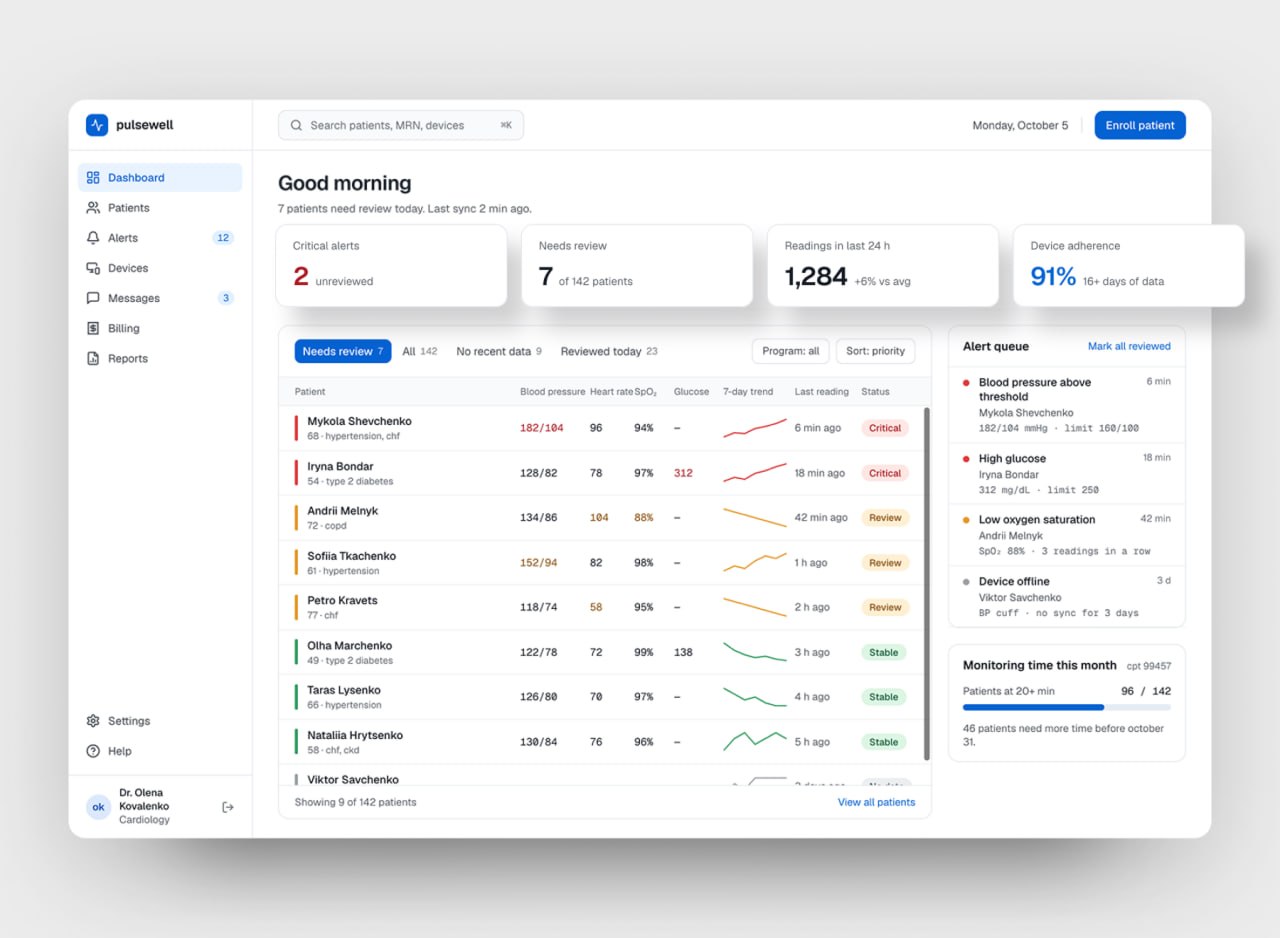
Remote patient monitoring software helps care teams track patients’ health remotely, detect changes earlier, and adjust treatment. IT Craft provides custom RPM software development services that help healthcare providers act sooner and tailor treatment to each patient — anytime, anywhere.
Remote Patient Monitoring Software Development Cost
Custom remote patient monitoring software typically costs from $30,000 for a basic MVP with a patient app and 1–2 connected devices, up to $400,000+ for an enterprise RPM platform with AI-powered analytics, multi-tenant architecture, advanced integrations, and multi-country compliance.
Remote Patient Monitoring Software Cost Estimates
| Project type | Estimated cost | Typical timeline |
|---|---|---|
| Basic RPM MVP | $30,000–$80,000 | 3–5 months |
| Standard RPM Platform | $80,000–$150,000 | 5–8 months |
| Advanced / Enterprise RPM Platform | $150,000–$400,000+ | 9–18+ months |
Key Cost Factors
Major factors that affect the RPM software development budget and timeline:
- Interoperability and integrations with EHR/EMR systems via FHIR APIs and Bluetooth or cellular medical devices.
- Compliance and security requirements, including HIPAA, GDPR, FDA guidelines, encrypted data storage, audit logs, and secure cloud infrastructure.
- Clinical rules engine complexity, including custom escalation pathways, alert logic, and reimbursement-related data tracking.
- Functional scope and complexity of the RPM platform, from a basic MVP to a full production-ready solution.
- Scalability and data processing requirements for continuous monitoring, real-time data transmission, and growing numbers of connected devices.
- Development team location and composition, which directly influence hourly rates and the overall project budget.
Challenges We Solve with Remote Patient Monitoring Software
Building an effective remote patient monitoring solution means addressing a range of clinical, regulatory, and technical complexities. We support you throughout the implementation process to overcome these key challenges:
Interoperability
Connecting RPM software with EHR/EMR systems, PACS servers, medical devices, and hospital IT infrastructure while enabling consistent, secure health data exchange.
Security and Compliance
Addressing patient data security, privacy, and reimbursement needs in line with applicable HIPAA, FDA, MDR, and Centers for Medicare & Medicaid Services (CMS) requirements.
Scalability and Performance
Building scalable RPM infrastructure that reliably collects, processes, and stores large volumes of real-time patient data from thousands of connected devices.
Real-Time Analytics and Insights
Using real-time analytics, reporting, anomaly detection, and AI-driven pattern recognition to detect changes in patient health and support timely clinical decisions.
User Experience
Designing intuitive patient and clinician dashboards with configurable reports, alerts, and health insights to improve engagement and support proactive care.
Development Costs
Keeping RPM development costs predictable through accurate estimation, clear scope planning, workflow automation, and efficient data processing while helping improve overall ROI.
Our Remote Patient Monitoring Software Development Services
We provide end-to-end support throughout the RPM software lifecycle, from consulting, requirements definition, and implementation planning to custom development, integration, launch, and ongoing optimization.
Custom RPM Software Development
Our development team combines design thinking, agile delivery, process automation, and DevOps to create user-focused RPM software.
Consulting
During consulting, we define system requirements, prioritize features, select the right technology stack, plan device integrations, and estimate potential ROI.
RPM Readiness Assessment
Our experts review technical, clinical, and operational readiness, identify adoption barriers, and outline priorities for a smooth RPM implementation.
RPM Roadmap and Strategy
We translate clinical goals into technical requirements, feature priorities, delivery milestones, and a practical roadmap for launching successful RPM solutions.
Integration Planning
To support interoperability, our integration specialists plan reliable connections between RPM software, EHR/EMR systems, monitoring devices, and existing healthcare technologies.
Security and Compliance Checks
Our compliance experts assess security requirements and implement controls aligned with HIPAA, HITECH, FDA, MDR, and other applicable regulations.
Change Management Advisory
With targeted training and communication planning, our change management advisors prepare healthcare teams for RPM adoption and workflow changes.
Support and Optimization
Our support team monitors performance, resolves issues, and delivers enhancements to keep RPM solutions reliable and current.
Core Components of RPM Software
The core components of remote patient monitoring software include:
- Patient Mobile App: Records vital signs such as blood pressure, glucose, and weight and allows patients to track symptoms.
- Clinician Dashboard: Aggregates real-time patient data and highlights alerts for high-risk cases.
- IoT Device Integration: Connects with pulse oximeters, ECG monitors, smart scales, and other external medical devices.
- Data Pipeline & Analytics: Ingests, processes, and normalizes device and sensor data using standards such as FHIR.
- EHR/EMR Interoperability: Exchanges RPM data with clinical systems through HL7 and FHIR protocols.
Key Features of Remote Patient Monitoring Software
The functionality of an RPM solution depends on specific clinical and operational needs. We implement the following features to enable continuous monitoring, timely interventions, patient engagement, and secure remote care.
Data Collection and Integration
- Continuous capture of vitals from medical devices, wearables, IoT sensors, and connected health trackers
- Integration with glucose monitors and other devices to detect abnormal readings such as hyperglycemia or hypoglycemia
- Clinical data mapping with LOINC, SNOMED CT, FHIR, and RxNorm
- Healthcare data extraction, cleansing, and normalization
Patient Health and Lifestyle Tracking
- Logging of symptoms, health changes, and warning signs
- Tracking of sleep, physical activity, walking distance, and lifestyle data
- Medication intake and adherence monitoring
- AI chatbots for collecting symptom information
Real-Time Monitoring and Visualization
- Real-time dashboards for patient measurements and health trends
- Vitals monitoring against predefined reference values
- Anomaly detection and predictive analytics for early intervention
- Automated alerts and escalation workflows for clinicians, patients, and caregivers
Advanced Analytics and Reporting
- Analysis of vitals, symptoms, lifestyle, and historical health data
- Detection of trends, disease progression, and medication side effects
- AI-powered care personalization and treatment insights
- Automated RPM reports on health trends and abnormal events
IoT Device Management
- Integration with multiple RPM and health tracking devices
- Real-time device failure and unusual activity detection
- Automated notifications for patients and medical staff
- Remote configuration of device parameters
Patient Engagement and Communication
- Secure patient–provider communication
- Virtual consultations and telehealth visits
- Messaging for symptoms, non-urgent questions, and device issues
- Practice management workflows for clinician–patient interactions
Accessibility Features
- Text-to-speech for visually impaired patients
- Voice controls for visual or motor impairments
- Large-font and high-contrast interface options
Billing, Compliance, and Security
- Automated billing, claims management, and eligibility verification
- Encryption of RPM data, telehealth recordings, and PHI
- Role-based access, multi-factor authentication, and security audits
- Compliance with HIPAA, CMS, Cures Act, GDPR, FDA, and MDR requirements
Key Development Steps for RPM Software
-
Scope & UX
Define clinical scope & UX, user roles, monitoring workflows, and accessible interfaces for users of all ages.
-
Data Ingestion
Build a secure, device-agnostic data ingestion layer for patient and device data transmission to cloud servers.
-
System Integration
Integrate medical devices, wearables, IoMT, EHR/EMR, and HL7/FHIR systems.
-
Billing & Tracking
Incorporate billing & tracking engines for automated time and readings capture and reimbursement workflows.
-
Security & Compliance
Ensure security and compliance aligned with HIPAA, GDPR, and SaMD requirements.
-
Testing & Deployment
Test, deploy, monitor performance, resolve issues, and deliver ongoing updates.
Remote Patient Monitoring Software Integrations
Integration is critical to the success of any RPM solution and to providing a comprehensive view of patient health. We help you build a connected, high-performing healthcare ecosystem by integrating your RPM software with existing systems, monitoring devices, tools, and third-party services:
EHR/EMR Systems
For unified access to diagnoses, test results, chronic conditions, medical history, patient vitals, recorded symptoms, appointments, and billing data.
Smart Patient Monitoring Devices
For real-time collection of health measurements such as heart rate, blood glucose, and SpO2 to support clinical analysis and track treatment effectiveness.
PACS and DICOM Servers
For medical imaging integration and smoother diagnostic workflows across connected healthcare systems.
Telehealth Integration
For consistent patient experiences across virtual consultations, appointment requests, scheduling, telehealth logs, and care coordination.
Cloud-Based Infrastructure
For secure, scalable data processing and reliable performance of enterprise-grade RPM systems.
IoT and Wearable Ecosystems
For continuous synchronization of patient data across connected sensors, wearables, and other remote monitoring devices.
Compliance and Security
We build compliance and security into RPM software at the design level, enabling automated compliance monitoring, secure patient data protection, and alignment with relevant healthcare and data protection laws, regulations, and standards, including:
Compliance
HIPAA, GDPR, FDA, EU MDR, CMS
Data security
Encryption, secure storage, access controls, MFA, audit logs
Security monitoring
Threat detection, access management, secure cloud infrastructure
Why Choose IT Craft’s RPM Software Services
- 20+ years in software development with extensive experience in healthcare IT.
- Expertise in HL7, FHIR, ICD-10, CPT, SNOMED CT, and HL7/FHIR-based integrations.
- Experience with FDA/CE requirements and HIPAA- and HITECH-compliant software development.
- Access to HIMSS-certified healthcare expertise for complex digital health projects.
- Microsoft Partner with strong cloud and healthcare technology capabilities.
- Expertise in IoMT, connected devices, and real-time health data.
Benefits of Custom Remote Patient Monitoring Software
With remote patient monitoring, clinicians track vital signs, manage chronic conditions, and step in early, all without an office visit. IT Craft designs intelligent RPM systems that connects patients, clinicians, devices, and health data. Our developers can help you:
Secure Custom Solutions
Build secure, cloud-native RPM solutions shaped around your clinical needs
Real-Time Patient Monitoring
Track patient health in real time for continuous clinical insight
Device & Data Integration
Connect wearable and home-based devices to power advanced PGHD analytics
AI-Powered Insights
Add AI-powered clinical decision support and predictive analytics for proactive care
Lower Care Costs
Cut patient care expenses by preventing complications and raising care quality
Fewer Missed Appointments
Lower missed appointments with online care delivery
Reduced Staff Workload
Free up medical staff by trimming routine monitoring and tightening schedules
Increased Healthcare Revenue
Grow healthcare revenue through stronger performance, new RPM revenue streams, and CMS incentive payments
What Determines the Success of a Remote Patient
With 20+ years in software development and deep healthcare expertise, IT Craft knows what drives RPM software adoption and ROI. Three factors matter most:
- In-built instructions for syncing smart connected medical devices with the RPM app and using them correctly, so patients get accurate readings (for example, precise blood pressure monitoring).
- AI-based care personalization drawn from patient diagnoses, collected vitals, logged symptoms, and lifestyle changes.
- RPM accessibility compliance aligned with Section 508 and other regulations, so patients with visual, motor, or other impairments can use every feature, whatever their tech experience.
Contributor
-
Healthcare IT Expert & Consultant