Speech Recognition in Healthcare: A Complete Guide
Key Technologies & Use Cases
 Overall review rating
Overview
Speech recognition in healthcare turns clinician and/or patient speech into digital text, either in real time or from recorded audio. This technology can transform spoken input into precise visit transcripts and ready-to-sign notes (a.k.a. ambient scribing), and it also allows AI voice assistants to understand natural language during patient calls for scheduling, intake, and follow-ups. IT Craft can develop healthcare software with voice recognition capabilities to accelerate clinical documentation.
Medical speech recognition solutions address the largest administrative burdens in healthcare: documentation and patient service. Research on ambient clinical intelligence (ACI) shows it can cut after-hours documentation for care providers by 2.5 hours per week.
Key Technologies
In healthcare speech recognition projects, IT Craft’s AI engineers usually work with:
- Noise cancellation, which filters out medical equipment beeps, hallway noise, and other background sounds before transcription.
- Speaker diarization, which separates the clinician’s voice from the patient’s automatically.
- Ambient scribing, which captures face-to-face visits and generates progress notes in real time (e.g., Sunoh.ai).
- Specialized medical models, which rely on domain-specific vocabularies for pharmacology, dosages, and medical terminology (e.g., Google Cloud Speech-to-Text medical models, Omi Medical).
Speech Recognition Use Cases in Healthcare
Ambient clinical documentation
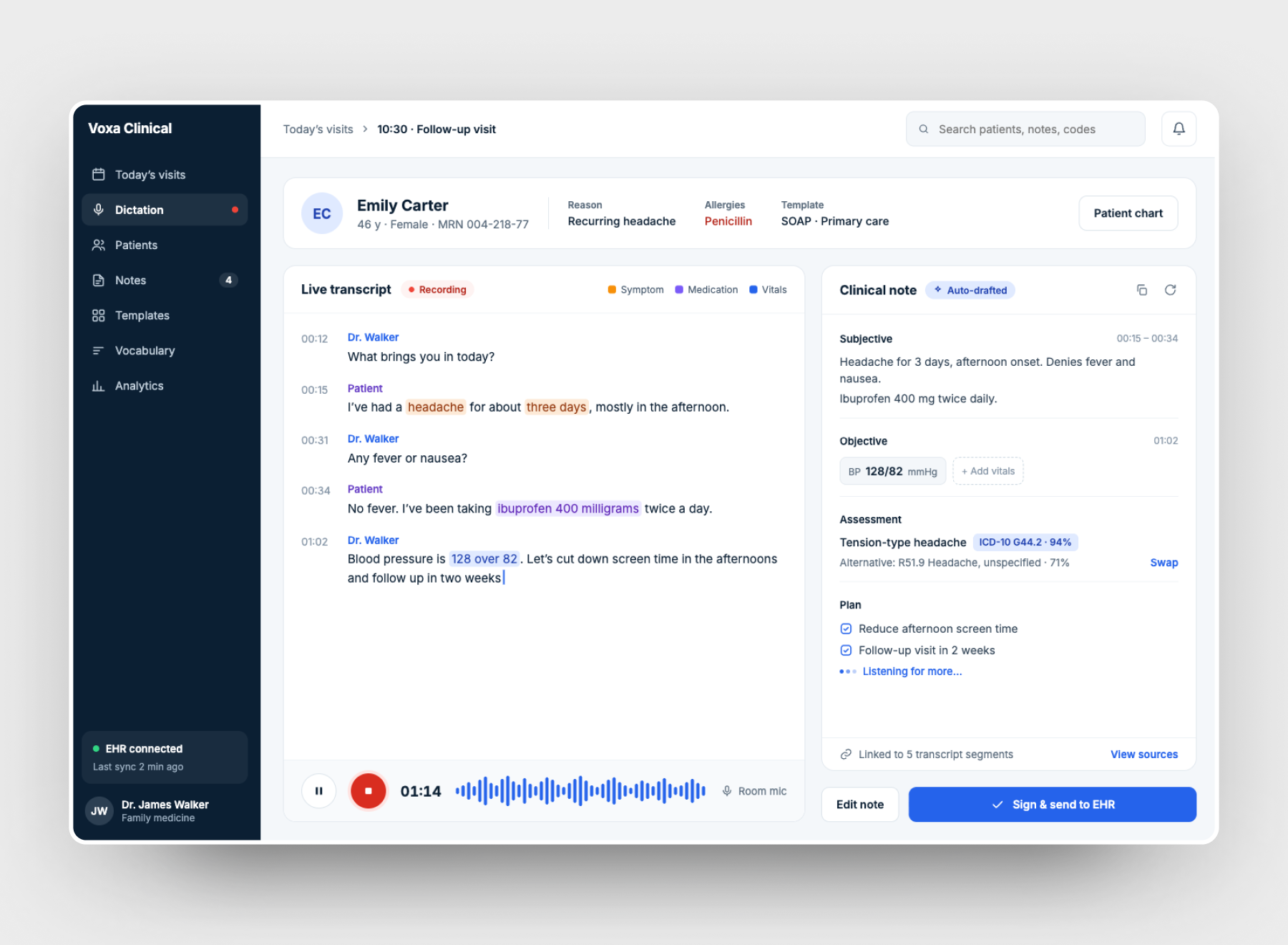
During in-person and virtual visits, the software records clinician–patient conversations (with patient consent), converts speech into text via automatic speech recognition (ASR) and speaker diarization, and uses large language models (LLMs) to generate clinician-ready drafts from visit transcripts, for example:
- Draft SOAP (Subjective, Objective, Assessment, Plan) or H&P (History and Physical) notes.
- Problem and medication lists, structured findings.
- After-visit summaries (AVS) and patient instructions.
- Key moments and “highlights” with links to relevant transcript fragments for quick clinician review.
- Dictated clinical documents formatted into the required note sections and EHR fields (e.g., referral letters, discharge summaries, procedure notes).
Real-time medical dictation
During in-person and virtual visits, the software records clinician dictation, converts speech into text via real-time transcription with ASR tuned to specialty-specific terminology, and formats the text into the required note sections and EHR fields, for example:
- Dictated findings (e.g., radiology, pathology, physical exam).
- Surgical summaries and procedure notes.
- Progress notes and discharge summaries.
- Referral letters and consultation reports.
- Hands-free records in trauma bays and sterile settings.
EHR navigation and voice commands
During in-person and virtual visits, the software records spoken commands, converts speech into text via ASR, and uses LLM-driven intent recognition and EHR integrations to execute actions in the patient chart, for example:
- Hands-free EHR navigation across charts, tabs, and data fields.
- Patient record retrieval by name, date of birth, or MRN (medical record number).
- Voice-activated note creation from specialty templates.
- Standardized order sets pulled up for physician confirmation.
- Spoken data entry into the selected field.
Patient communication
AI voice agents can combine ASR, LLM-driven dialog, and integrations with clinical and administrative systems to autonomously handle live patient calls, for example:
- Handle appointment booking and rescheduling and confirm details (e.g., insurance, preferred time).
- Run pre-visit intake questionnaires and collect patient information with branching questions.
- Provide visit preparation instructions and logistics based on provider-approved content.
- Make follow-up and reminder calls and manage responses (with escalation rules for urgent cases).
- Route complex requests to staff and pass a structured handoff summary.
Voice biomarkers
During in-person and virtual visits, the software records patient speech and breathing (with patient consent), converts audio into acoustic features via voice and speech analysis and respiratory sound analysis, and uses machine learning models to flag early signs for screening, for example:
- Neurological disorders (e.g., Parkinson’s disease, ALS).
- Mental health conditions (e.g., depression, anxiety).
- Respiratory conditions (e.g., COPD, asthma).
- Cognitive decline (e.g., early-stage Alzheimer’s disease).
- Vocal cord and voice fatigue disorders.
Architecture
Below, IT Craft’s AI architects outline a reference architecture of an open-source ambient scribe and walk through each step of its pipeline, from automatic speech recognition (ASR) to EHR integration.
Our team usually advises open-source components, as they support on-premises or private-cloud hosting and leave PHI processing fully under the provider’s control. Such code is also open to changes, so the scribe can follow a specific clinic’s workflows, note formats, and terminology. On top of that, the solution avoids per-user or per-minute license payments, which makes a difference as the number of physicians grows.
-
Ambient Scribe Stage 1: Audio Processing and Transcription
The first stage turns clinician–patient audio captured in the room into readable text split by speaker. To start, SpeechBrain noise reduction strips out equipment beeps, hallway sounds, and other interference. Then, Whisper transcription converts the cleaned recording into words. Alongside it, speaker diarization with pyannote.audio marks which segments belong to which participant. At the end of this stage, both results merge into one speaker-labeled transcript with timestamps.
-
Ambient Scribe Stage 2: Clinical Note Generation
At stage two, the transcript becomes the basis for clinical documentation. Here, retrieval-augmented generation (RAG) anchors the model’s output in provider-approved knowledge in a vector database and in patient context retrieved via HL7/FHIR from the EHR. Depending on the specialty, this context can cover diagnoses, allergies, current prescriptions, past procedures, test results, and earlier visit records. Drawing on both sources, a clinically tuned Llama 3 model writes draft SOAP notes and suggested actions (e.g., orders to place, follow-ups to schedule).
-
Ambient Scribe Stage 3: EHR Integration and Clinician Review
The third and final stage passes AI-generated drafts to the provider’s records system for staff to check. An integration layer connects the scribe with that system: it packs each AI output into HL7 or FHIR messages. These messages go through secure EHR APIs to the target platform (e.g., Epic, Cerner, OpenEMR), where physicians read, correct, and confirm them during clinician review and sign-off. Only approved notes are saved to the patient record.
Contributor
-
Healthcare IT Expert & Consultant