Custom Healthcare Mobile App Development
Since 2001, IT Craft has been co-creating healthcare mobile apps with providers, digital health startups, and medical organizations. Our 330 experts support clients at every step, from concept and design to launch and evolution, building apps that improve care accessibility for patients in remote areas and between visits.
 Overall review rating
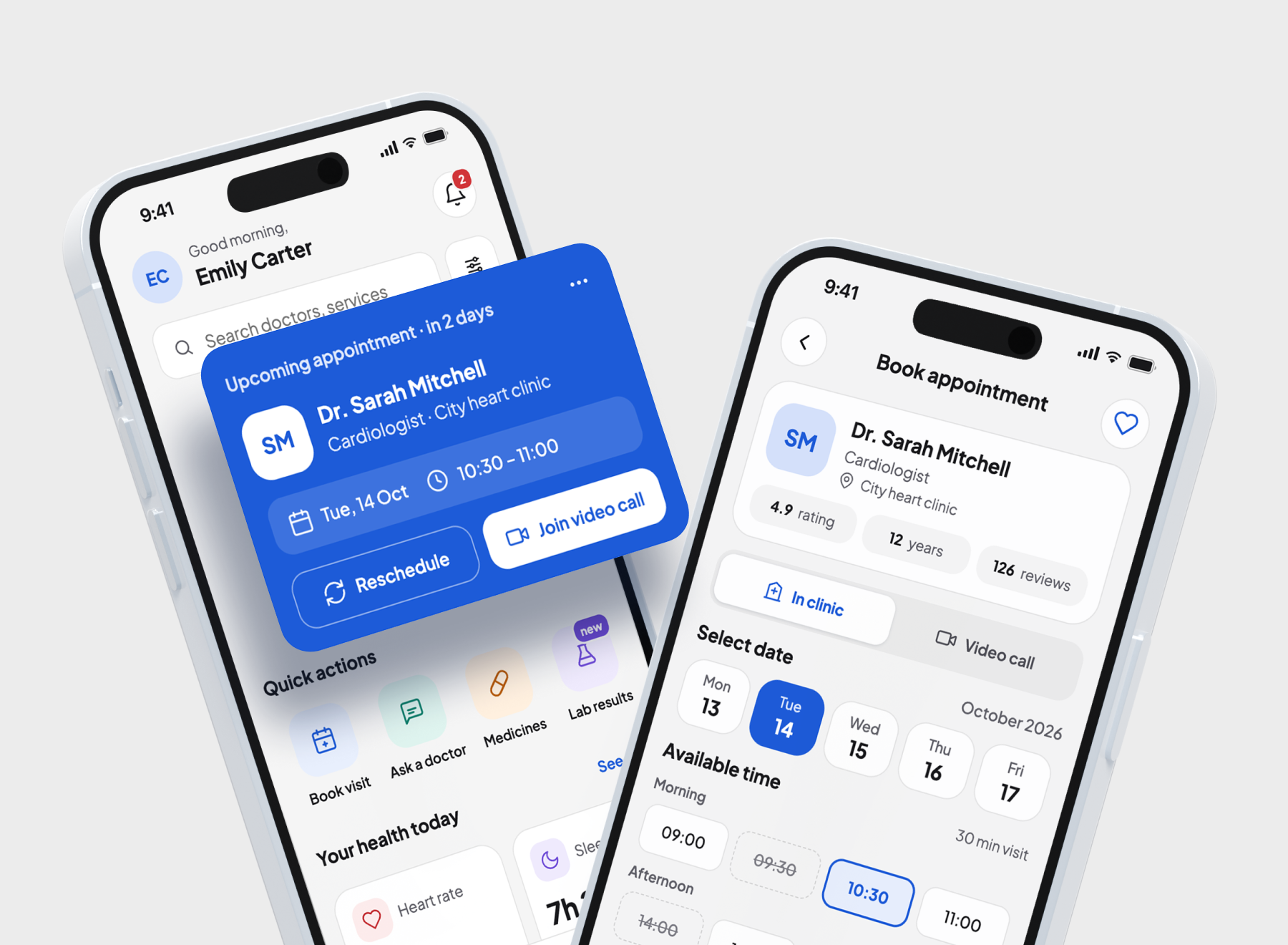
Healthcare mobile app development is aimed at delivering HIPAA-compliant iOS and Android software that patients and medical staff use on the go. IT Craft’s custom apps support visit scheduling, patient examination records, test results, treatment follow-ups, remote monitoring, and more.
Why Develop a Healthcare Mobile App with IT Craft
- 20+ years of experience in software development, including apps for healthcare providers, wellness platforms, and healthcare staffing companies.
- 330 experts on board, including business analysts, UX/UI designers, developers, and QA engineers.
- 4.9 rating on Clutch based on verified client reviews.
- Proven record of delivering FDA- and HIPAA-compliant software, plus GDPR-ready apps for EU users.
- Hands-on experience with HL7 and FHIR for EHR interoperability, DICOM for medical imaging, and ICD-10 and CPT for medical coding.
- Security by design: encryption at rest and in transit, RBAC, MFA, and mobile security testing against the OWASP Mobile Top 10.
- Offices in the USA, Germany, and Estonia.
Cost and Time Estimates
The cost of custom healthcare app development typically ranges from $30,000 for a Minimum Viable Product (MVP) to $500,000+ for a complex enterprise ecosystem, with a development timeline of 2 to 18+ months.
Cost Overview by Complexity
Most of the price gap comes from the app's complexity. Here are sample price ranges and timelines for three complexity tiers:
| Complexity | Average Cost |
|---|---|
| Basic / MVP | 30,000–80,000 |
| Medium | 80,000–200,000 |
| Enterprise | 200,000–500,000+ |
Key Drivers of Healthcare Development Costs
The cost of a healthcare app varies a lot and depends on multiple factors. Below, IT Craft's healthcare IT experts list the top 4 cost drivers, with the first three moving the price the most:
- Feature Complexity: App complexity, from basic functionality (e.g., sign-up, booking, reminders) to advanced workflows, real-time communication (e.g., video visits, live vitals), and automation.
- Security & Compliance: Regulatory compliance requirements (e.g., HIPAA, GDPR), incl. data encryption, RBAC, and audit logs.
- System Integrations (APIs): Third-party integrations, from standard payment (Stripe) and communication (Twilio) APIs to connections with EHR systems like Epi, Cerner via HL7 and FHIR protocols.
- Platform Choice: App platforms and approach: cross-platform development (Flutter, React Native) or separate native apps for iOS and Android.
*The final budget and timeline depend on the app’s feature set, compliance requirements, and integration scope.
Types of Mobile Health Apps We Develop
mHealth applications differ in target users, platform (iOS, Android, or both), and the compliance scope they need. Below, IT Craft's consultants share examples of apps commonly requested by our clients from the healthcare domain, each built with data security and privacy regulations (HIPAA, GDPR) in mind:
Client Pain Points and Solutions
Below there are the most common client challenges seen by IT Craft engineers when they develop applications for the healthcare sector, along with solutions to address them:
-
"Our app needs to handle sensitive health data without putting patients or our business at risk."
We keep PHI out of push notifications or server logs, and the app-switcher preview and store it only with vendors that sign a BAA. Every access to patient data we protect by role-based permissions and MFA and recorded in audit logs.
-
"We need to connect our app to EHRs, EMRs, labs, pharmacies, and medical devices."
To connect your app to clinical systems, we use SMART on FHIR for EHR/EMR platforms and HL7 v2 for labs, mapping lab codes to LOINC. E-prescribing goes through a certified Surescripts partner, and medical devices pair over Bluetooth LE or the manufacturer's SDK.
-
"Our existing healthcare app is slow, outdated, and difficult to maintain."
First, we audit the code and cover its current behavior with tests. Then we replace outdated modules one at a time, so clinicians keep working on the app, and move Xamarin apps (unsupported since May 2024) to .NET MAUI.
-
"We want to launch a telehealth feature, but we're terrified of data leaks during live calls."
For video visits, we use WebRTC and a vendor that signs a BAA, keep patient names out of room names and chat text out of logs, then send recordings only to storage you own. When a call requires it, we add end-to-end encryption.
-
"We have a mountain of medical data, but we can't extract any actionable insights from it."
We bring EHR, lab, billing, and device data into one FHIR or OMOP model, map lab codes to LOINC, and merge duplicate patient records. On top of that clean layer, we build dashboards around questions your staff act on, such as missed follow-ups.
-
"The app has to work with wearables, video visits, and bad Wi-Fi, all at once."
We sync wearable data through HealthKit and Health Connect and keep readings on the device until the connection returns. On weak networks, our video calls fall back to audio only, and we test Bluetooth pairing on several Android phone models.
-
"We are ready to scale, but our legacy backend architecture is holding us back."
Depending on what profiling shows, we tune slow queries and add connection pooling, read replicas, and caching. Only high-load modules (e.g., video, notifications) are moved to separate services on HIPAA-eligible cloud infrastructure (AWS/Azure Healthcare APIs).
Our Successful Healthcare Mobile App Development Projects
Native iOS App for a Self-Help Audio Library with 500,000+ Users
IT Craft developed a native iOS app for Hypnosis Downloads, the self-help audio library by Uncommon Knowledge, as the brand's first step into mobile. Our team connected the app to the existing website and keeps it compatible with each new iOS release.
SaaS Development for a Records Retrieval Company Serving US Personal Injury Firms
Since the 2019 MVP, IT Craft's .NET and Angular engineers have built and scaled Arctrieval, a HIPAA-aligned SaaS product for requesting medical and billing records on behalf of US personal injury firms. Our team covers platform engineering, API and integration development, and DevOps support. Created with IT Craft's help, the system now processes tens of thousands of requests daily.
Healthcare CRM Platform with AI integration for Workforce.AI
IT Craft helped Aya Healthcare, which acquired the hospital analytics company Flexwise Health in 2023, finalize and launch Workforce.AI, a platform for hiring and managing healthcare professionals, and scaled the development team from 6 to 17 specialists over an eight-year partnership.
Healthcare Mobile App Development Services by IT Craft
App Consulting & Development
Our consultants and mobile developers handle market research, requirements planning, UX/UI design, HIPAA-compliant development, and third-party integrations for healthcare apps. This gives you a realistic scope and budget before coding starts and an app ready for compliance review at release.
Support & Enhancement
We provide app maintenance, troubleshooting, and L1–L3 support after launch, helping healthcare companies keep their apps stable through compliance monitoring, feature expansion, and cloud migration.
Modernization
IT Craft delivers modernization projects that turn outdated healthcare apps into maintainable products through UX/UI redesign, performance optimization, AI/ML integration, security upgrades, cloud migration, and cross-platform QA.
Core Features of Healthcare Mobile Apps
Based on our experience delivering healthcare software, IT Craft presents the key features and functionality of award-winning healthcare mobile apps most commonly requested by our clients, patients, and healthcare providers.
Telehealth & Remote Care
- Virtual consultations
- Remote patient monitoring
- Connected device data sync
- Self-service tools for patient convenience
Patient Communication
- Secure messaging
- Video communication
- File and photo sharing
- Continuity of patient-provider relationships
Appointment Scheduling
- Online appointment booking
- Live wait times
- Reminders to prevent no-shows
- Calendar sync
ePrescriptions & Medication Management
- Electronic prescriptions
- Refill requests
- Medication adherence reminders
- Drug interaction alerts for patient safety
Symptom Checking & Virtual Triage
- Guided symptom input
- AI urgency assessment
- Personalized care recommendations
Medical Image & Video Recognition
- AI image recognition
- Extended diagnostic capabilities
- Integration into medical workflows
Health Tracking & Analytics
- Health metrics dashboard
- Progress monitoring
- Insights for wellness decisions
Health Education
- Health education library
- Content for health literacy
- Plans for proactive self-care
Payments & Insurance
- In-app copayments
- Insurance claims tracking
- Secure transactions
PHI Protection
- Encryption protocols
- Role-based access controls
- Data privacy setting
Integrations
We integrate healthcare mobile apps with clinical, analytics, and CRM systems to support healthcare interoperability, improve digital health effectiveness, and create a connected IT ecosystem for informed decision-making and higher provider productivity.
Telehealth Solutions
We connect telehealth solutions with your iOS/Android apps so that video conferencing and audio consultations fit into flexible clinical workflows.
Remote Patient Monitoring Solutions
By syncing the app with ECG & heart rate monitors, glucose meters, and fitness trackers, we bring patient health data into the app in real time.
Patient Portal Solutions
We link patient portal solutions with your app to keep appointment scheduling, visit ratings, test results, and educational information up to date on every device.
Health Data Analytics
By tapping into health data analytics platforms, we allow the app to turn healthcare data processing and clinical predictions into mobile data visualization for data-driven decisions.
Healthcare CRM
Our team facilitates CRM-mHealth integration to give healthcare professionals patient information access and mobile customer care tools on the go.
EHR/EMR Software
We integrate your app with EHR/EMR systems through HL7/FHIR to give clinicians secure access to patient health records, appointment scheduling, and treatment prescriptions in line with HIPAA compliance requirements.
Our mHealth App Development Process
The mHealth app development process at IT Craft is aimed at delivering a working product to patients and clinicians while keeping app quality and data security at the center. Our approach covers end-to-end mHealth development, from business analysis and MVP development to post-deployment support, and follows HIPAA, GDPR, and FDA requirements where they apply.
Here are the main steps we follow:
-
Research, Discovery & Planning
What we do:
Our business analysts study the target audience and its needs, collect business requirements, and plan the project scope and delivery.
What you get:
A clear app concept, a prioritized feature list, a functional specification, and a cost and time estimate. -
UX/UI Design
What we do:
We map patient journeys and doctor journeys and turn them into the interface design, from wireframes to a clickable prototype.
What you get:
A tested app design that patients, doctors, and caregivers can use without training.
In healthcare, the same app is often used by a 70-year-old patient with poor eyesight and a nurse with a minute between rounds. We are thinking about both: large tap targets and the most common actions no more than two taps away. When patients can book a visit or log a reading without calling the clinic, they keep using the app.
Roman Provotorov, Healthcare IT and Web & Mobile Development Expert, IT Craft -
Architecture & Development
What we do:
IT Craft builds the frontend and backend in iterative 2–4 week sprints, designing the architecture for scalability from the first release.
What you get:
A working first app version or an MVP in 3–5 months. -
Healthcare System Integration
What we do:
We integrate the app with your internal systems via HL7 and FHIR, including EHR/EMR, RIS/LIS (radiology and laboratory information systems), and billing tools.
What you get:
Data exchange between the app and your clinical systems without manual re-entry. -
Testing & Compliance
What we do:
Our QA engineers find and fix bugs, check usability on real devices, and run quality assurance for data security and HIPAA/GDPR compliance.
What you get:
A tested, secure app ready for compliance review.
In the US, every app that processes patients' data must meet HIPAA requirements such as access control, audit controls, and ePHI integrity. FDA oversight applies to apps with Software as a Medical Device (SaMD) functions, e.g., heart rhythm analysis with a smartphone sensor. IT Craft's business analysts help you identify which rules apply to your app before development starts.
Roman Provotorov, Healthcare IT and Web & Mobile Development Expert, IT Craft -
Deployment & Launch
What we do:
We complete system integration in your IT environment and support acceptance testing with your staff.
What you get:
A deployed app connected to your systems and approved by its users. -
Maintenance & Evolution
What we do:
IT Craft provides ongoing support, performance monitoring, and bug fixes, and ships feature updates for patients and doctors based on user feedback.
What you get:
An up-to-date app with quick issue resolution.
You can engage IT Craft for the full process or for separate steps, such as UX/UI design or HL7 integration.
Technologies We Use
IT Craft bases technology selection for mobile healthcare applications on your project goals, target users, and the devices the app must work with.
Benefits of Custom Healthcare Mobile App Development
We help healthcare companies improve patient care and gain numerous advantages to get ahead of their competitors:
Process & Cost Optimization
Digital transformation, and mHealth solutions in particular, allow medical specialists to provide remote care from anywhere, which optimizes their workday and frees them from routine tasks through workflow automation. Our mobile apps also enable staff to streamline everyday operations, improve resource utilization, and reach higher operational efficiency.
Improved Health Outcomes
IT Craft implements mHealth software that encourages patient self-management, helping people become more proactive in preventive care and healthy lifestyles. Automated notifications about medication intake, immunizations, or appointments also support medication adherence and more continuous treatment, resulting in fewer readmissions, urgent cases, and adverse reactions.
Enhanced Patient Engagement
By developing mHealth apps, we help providers facilitate convenient and clear patient communication, which improves patients' trust, retention, and treatment participation.
New Business Opportunities
We create mobile apps to enhance your existing services, find new ways of monetization, or drive service expansion with mobile care. Advancements in your digital health offering can also support patient acquisition and convince loyal patients to sign up for more advanced care options.
Better Mobile UX & Staff Productivity
Our mobile apps give medical staff task-oriented workflows, intuitive navigation, and streamlined interfaces, which shorten onboarding and free clinicians from extra taps and screens. As a result, nurses and physicians spend less time on routine actions, improving staff efficiency across shifts.
Secure Healthcare System Integration
IT Craft implements mHealth apps that connect to existing systems via EHR integration and practice management and scheduling software, which removes duplicate data entry. Role-based access controls also ensure authorized data access, so each user sees only the patient information their role requires.
Contributor
-
Healthcare IT Expert & Consultant