Healthcare Web Development and Design
Full-cycle medical web design and development for healthcare providers and companies that need engaging web-based platforms for patients, clinicians, and partners. IT Craft has been building healthcare web solutions since 2001, from a clinic’s first booking page to enterprise portals used across US hospitals.
 Overall review rating
Why IT Craft
- Healthcare web design and development since 2001.
- 330 experts, with a Clutch rating of 4.9.
- Engineering for SaMD (software as a medical device) projects, with documentation and testing kept audit-ready.
- Practical knowledge of healthcare data standards: FHIR, HL7, ICD-10, CPT, XDS/XDS-I, SNOMED CT.
- Compliance with HIPAA, HITECH, GDPR, and PIPEDA built into architecture, hosting, and forms.
- Research-based UX/UI design: user interviews, journey mapping, and usability tests with patients and medical staff.
Costs and Timelines
Healthcare website design and development costs range from $5,000 for a basic corporate brochure site to over $200,000 for a complex enterprise web-based app platform. A project may take 4 weeks to over 12 months, depending on its technical complexity and regulatory requirements.
Cost and Timeline Breakdown by Project Type
| Project Type | Average Cost Range (USD) | Average Timeline |
|---|---|---|
| Brochure / Corporate Practice Site | $5,000 – $20,000 | 4 – 8 weeks |
| Patient Portal & Intake Systems | $25,000 – $120,000 | 8 – 12 weeks |
| Telehealth & Telemedicine Applications | $70,000 – $180,000 | 6 – 12 months |
| Enterprise Mult-Role Platforms | $150,000 – $250,000+ | 12+ months |
Key Cost and Timeline Drivers
Major factors that affect the development budget and timelines are:
- The healthcare web solution’s project type.
- The number and complexity of integrations with EHR systems and hospital databases.
- Security, data encryption, and regulatory compliance requirements (e.g., HIPAA).
- The required content readiness (medical copy, imagery, practitioner credentials).
- (for outsourced development) A vendor’s development team location.
*The final budget and timeline depend on the solution’s complexity, compliance requirements, and integration scope.
Challenges and Solutions
Below are the most common challenges our clients face in healthcare web development and design, along with the solutions IT Craft engineers provide to address them.
-
"Our website looks like it was built in 2012, and patients notice."
Our designers redesign healthcare websites to look as professional as the practice itself, with clean, calm interfaces, real provider stories, and clear paths to booking that turn visitors into patients.
-
"Our last web team didn’t understand how patients or medical staff actually use the website.”
IT Craft builds around real healthcare journeys: finding the right provider, booking appointments, completing intake forms, and accessing records. Clear navigation, accessible design, and mobile-friendly interfaces make each step easier.
-
“Patients book online, but our staff still enter everything into the EHR manually.”
Our engineers connect websites with EHR/EMR systems, scheduling platforms, labs, and payment services through APIs and HL7/FHIR where applicable. Connected workflows reduce duplicate entry and keep patient information aligned.
-
“We have patient data scattered across three different legacy databases, and nothing talks to each other.”
IT Craft starts with an inventory of all data sources and a common FHIR-based data model. Records from legacy databases, the CRM, and the patient portal are then validated, deduplicated, and merged into unified patient profiles, with real-time, secure synchronization between systems.
Types of Medical Web Solutions We Develop
Web applications
IT Craft develops web apps for four groups of tasks:
- Care delivery assistance: diagnostic web apps and clinical decision support apps (e.g., risk scoring, dosage checks).
- Patient information storage and sharing: hospital information systems and their modules (registration, records, discharge).
- Patient care and monitoring: chronic disease management apps, telemedicine apps, and outpatient care apps.
- Internal processes automation: hospital inventory management apps, staff scheduling, claims checks, and more.
Medical websites
Business websites
For hospitals, health networks, outpatient clinics, nursing homes, and private practices (services, locations, providers, insurance accepted, etc.).
Catalog websites
Product catalogs for medical device manufacturers, pharmaceutical companies, and healthcare software product companies, with filters, spec sheets, and quote requests.
Landing websites
One-page sites for medical startups to present a product, collect waitlist sign-ups, or support a funding round.
Health education websites
Courses and reference materials for medical students, doctors in clinical training, and patients (e.g., condition guides, video lectures, quizzes).
Key Features of Our Medical Websites:
- Physician profile pages with specialties, languages, and open slots.
- Online appointment booking and payment.
- HIPAA-compliant contact and intake forms.
- WCAG 2.1 accessibility (AA level).
- Multilingual support for diverse patient communities.
Medical web portals
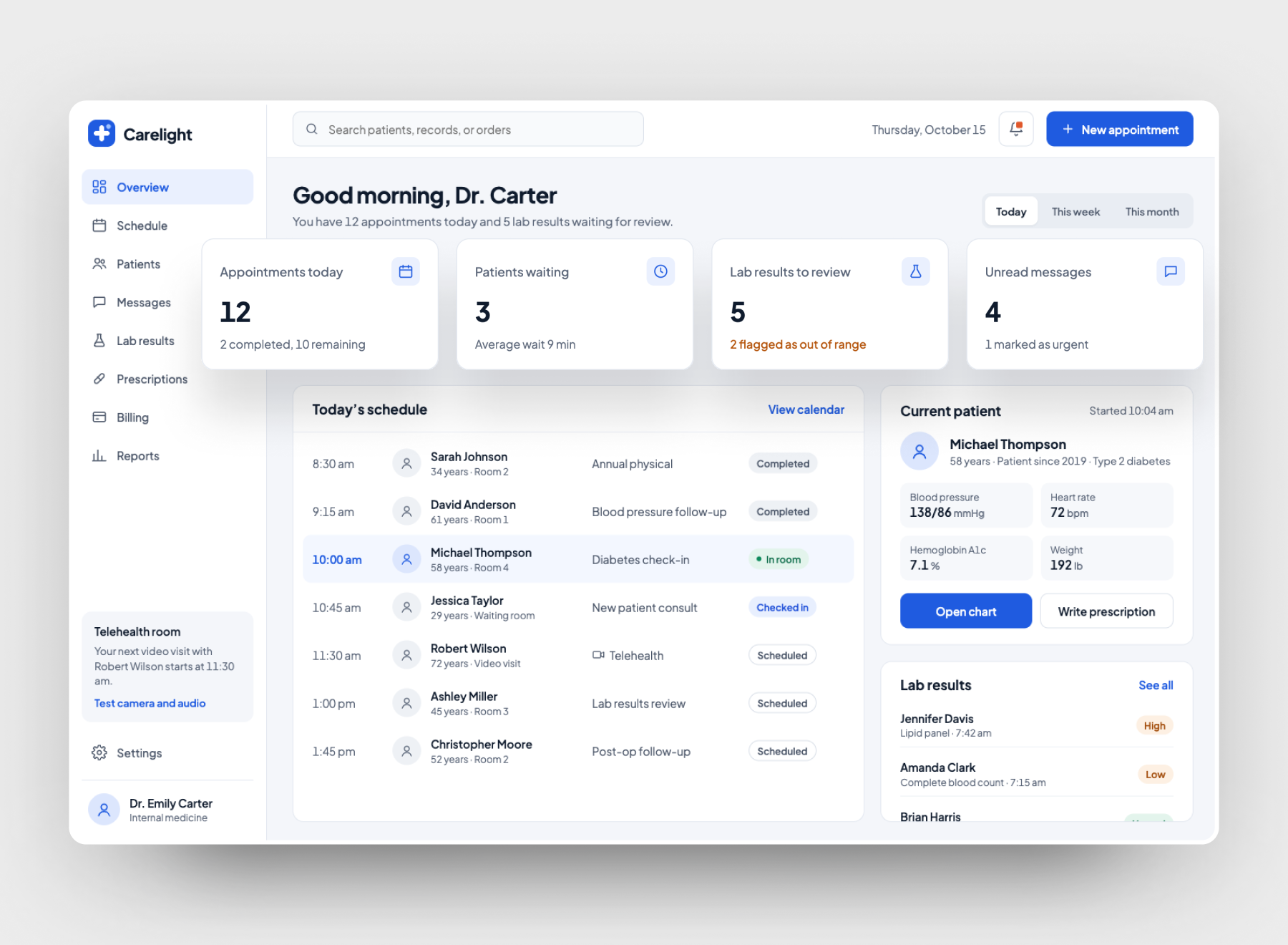
- Patient portals with telemedicine functionality, access to health information, appointment scheduling, and virtual care, incl. portals for mental health services.
- Portals for healthcare employees: HR software, workflow automation, and expertise sharing within medical teams.
- Portals for diagnostic laboratories with appointment scheduling, test results access, and online payment for laboratory services.
- Pharmacy portals for online refill ordering, off-the-counter medications and wellness products, plus on-site pharmacy services booking (e.g., vaccinations).
- Portals for wellness and preventive care: proactive health management, risk assessments, and preventive care recommendations.
- Clinical trial participant portals that host trial-related information, remote trial activities, and participant training and support.
- Healthcare information portals with medical articles, drug information, symptoms checkers, and news.
- Medical supplier portals for medical supplies, equipment, and pharmaceuticals: offer submission, sourcing events, order receipt, etc.
Our Healthcare Web Development Projects
8-year partnership, team grown from 6 to 17: Workforce.AI for Aya Healthcare
IT Craft was the core engineering partner for Workforce.AI, a web-based platform for clinic staffing, scheduling, and workforce planning that Aya Healthcare acquired in 2023. The app forecasts patient demand and staffing up to 12 months ahead and is used by hospital administrators across the US.
Tens of thousands of HIPAA-aligned record requests a day: Arctrieval
IT Craft built a SaaS platform for a legal-tech company that retrieves medical and billing records for US personal injury firms, starting with an MVP in 2019. The platform now handles certified correspondence by email, fax, and postal mail, digital signing, audit trails, and an external API for large firms’ case systems.
Claims audit web app that checks diagnosis and procedure codes: DRG Claims Management
For healthcare-focused insurance providers, IT Craft developed a HIPAA-compliant web app with a custom audit algorithm for diagnosis and procedure codes. Insurers upload documents, track claim status, generate audit reports, and keep proof of appeal for provider negotiations.
Patient support portal with direct access to certified clinicians
IT Craft built a secure web portal for a healthcare provider whose patients have complex medical needs. The portal offers condition-specific content paths, validated treatment information, and a direct channel to certified specialists, with SMS and email notifications (SmsBroadcast, SendGrid).
Core Strengths of Our Healthcare Web Solutions
Integration with internal systems
We integrate your web solution with EHR/EMR, practice management, scheduling, billing, and other internal systems (relevant for hospital websites, patient portals, disease management web apps, etc.).
Content management system
We equip your web solution with a user-friendly CMS for easy content updates and content editing, so your non-technical employees don’t have to call a developer every time they need to post a new article.
Backend for a mobile app
Your web platform can also work as a mobile app backend, giving patients patient health data access from their devices, along with social media integration and push notifications.
High performance
By optimizing your web platform, we ensure a stable backend/frontend connection. Even under heavy data loads, your resource provides fast content display and accurate content delivery.
Healthcare-grade security & compliance
We ensure HIPAA-compliant hosting and data transmission, encrypted forms, role-based access, secure authentication (MFA/SSO), audit trails, and GDPR-compliant cookies and consent management.
Responsive design
Your patients are on the go, so your web platform should be too. Move beyond desktop-only design and turn your website into a go-to resource for patients with mobile access on any device, plus cross-device, browser, and platform compatibility.
Key Features of Healthcare Web Solutions
Content personalization
This patient retention technique helps with patient reengagement (e.g., patients who visited the facility a while ago). We add the following content personalization methods to help you attract new patients and grow revenue:
- Recently visited section to let web solution users go back to where they left off, resuming previous website activity.
- Geolocation (e.g., to show the closest medical facilities first).
- Personalized promotions and personalized offers within the web solution.
- Loyalty systems with bonus points, cumulative discounts, and other incentives.
- Interactive features like diet calculators, slide-to-compare before-and-after photos, videos, charts, and more.
The web platform personalizes content based on patient data such as: HIPAA-compliant EHR/EMR data, browsing history from previous visits, current browsing behavior, information about relatives.
Patient engagement tools
To help patients take an active part in patient wellbeing activities, our web solutions give them access to reliable medical information and healthcare services:
- Information about staff members, featuring a few words about physicians and nurses, their photos and achievements, to help build patient-team rapport.
- Online self-registration options to let patients easily complete online appointment check-in or handle visit scheduling.
- Health plans guide to explain treatment options to patients with transparent information and bring reduced administrative workload for front-desk staff.
- Health education to share health knowledge, track patient interests better, and offer more relevant content personalization.
- Interactive Q&A chat to give website users immediate support, improve visitor conversion, and strengthen existing client relationships.
- Motivation elements with milestones, challenges, and achievements to help patients build healthy habits by setting goals.
- Social media integration to help users share aspirations and achievements with friends and family across popular social media apps.
- Medical quizzes to bring gamification into health learning.
Embedded patient portal
Patients need to track their health data, treatment progress, examination results, billing information, etc. So, based on our 20+ years of experience in healthcare software and medical website development, we build these key features and make sure they comply with HIPAA, HITECH, and other applicable regulations.
Web analytics
When filling the web platform with interactive and SEO content, we suggest going beyond general analytics tools, such as Google Analytics, and tracking the following metrics:
- Interest in particular services.
- Patient engagement level.
- Personalized content effectiveness.
Our Development Approach
Our medical web development services cover all stages, from idea inception to launch and support.
-
Business analysis
IT Craft’s business analysts with 10 years of healthcare experience run market analysis, define your competitive advantage, and gather platform requirements. The outcome is an agreed scope and feature set for the first release.
-
UX and UI design
Our designers begin with user needs analysis and competitor research, then map user journeys for patients and staff. They build interactive wireframes, run user testing, and turn approved screens into final interfaces and a UI kit.
-
Development of a medical web solution
We develop healthcare web solutions on a custom or platform-based CMS, depending on how often content changes and how complex the logic is. HIPAA compliance, user access management, and patient data encryption are part of the build from the first sprint.
-
Integration with the IT environment
IT Craft engineers set up HL7 integrations and EHR/EMR interoperability (incl. FHIR APIs), and connect the solution with hospital and patient applications, practice management systems, and customer management systems.
-
Quality assurance of a medical web solution
Our QA engineers perform functional testing, integration testing, security testing, and accessibility testing (WCAG 2.1), plus HIPAA compliance checks before each release.
-
Healthcare web software implementation
After defect and bug elimination, we handle solution deployment and prepare training materials for patients, medical staff, and medical content contributors.
-
Medical web software support and maintenance
We provide L1/L2/L3 support and maintenance to keep high availability and reliability. Over time, our team takes care of software evolution: functionality and design improvements based on analytics and user feedback.
Engagement Models
Dedicated Team
We assign a team of healthcare web designers, developers, and QA specialists who work only on your project. The team’s size and composition change as your product grows.
Best for: Long-term healthcare web projects, ongoing development, evolving functionality, medical software integrations.
Staff Augmentation
We provide healthcare web specialists who join your existing team and report to your managers. Thus, you close skill gaps and increase development capacity without hiring in-house.
Best for: Healthcare organizations with an in-house team that need additional expertise.
Project Outsourcing
This option is similar to a fixed-scope project: we take over the whole healthcare web project, from requirements and design to development, testing, and launch. The payments are bound to the project’s milestones.
Best for: Healthcare organizations that need full-cycle delivery of a medical project.
Technologies We Apply in Medical Web Design
Contributor
-
Healthcare IT Expert & Consultant